



Abu Dhabi
Mufakiru Alemarat
Prof. Dr. Ali Mohammed Al-Khouri
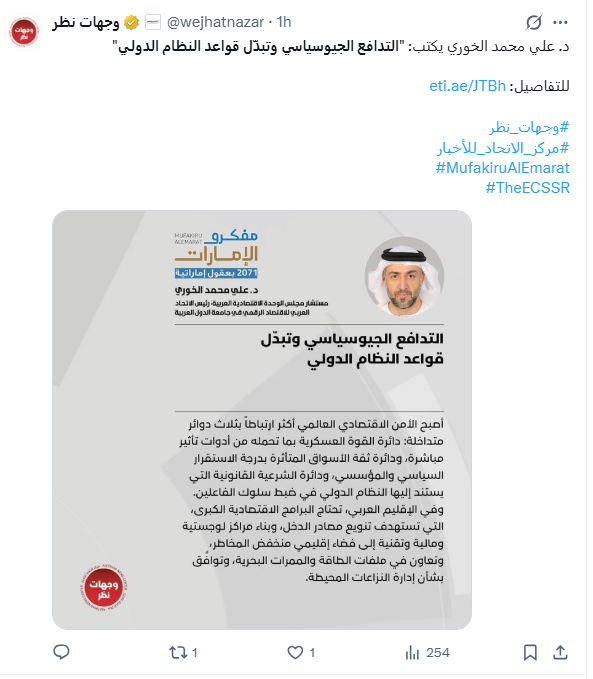
The rapid pace of events on the international stage reveals a delicate phase in which the balance of power and the methods of interaction between key players are being reshaped, amidst escalating tensions evident in energy markets, investment flows, and power dynamics. Despite the geographical distances involved, the nature of these events demonstrates that the international system has become so interconnected that any local disturbance is linked to a broader global landscape where the rules of political, economic, and security action are being redefined. Within this increasing interconnectedness, traditional stability mechanisms are undergoing quiet, unannounced reassessments, intersecting with major trends centered on the transformation of the international environment towards new standards of international conduct and an ongoing debate between security requirements and development plans, all within a changing reality that transcends the experiences of the past two decades. Amidst the threads of this complex landscape, indications emerge suggesting that the ongoing transformations represent the beginnings of the crystallization of new global governance models that will influence the rhythm of international relations in the coming years.
The rise of the “geo-economic security” logic
What cannot be simplified in the current landscape is portraying the tensions between the major powers as merely formal or temporary disagreements. Reports addressing the future of the global economy point to profound shifts in the positions of nations, particularly developing ones, within the global system. These shifts include the emergence of middle powers seeking to maintain traditional security guarantees from major powers, and others moving towards greater autonomy in security and military decision-making, coupled with a calculated repositioning in energy markets and trade and investment chains. This is accompanied by a broadening of the concept of “security” to encompass economic, logistical, and technological dimensions, which are now considered as influential as traditional military power considerations.
Simultaneously, ambitious economic transformation programs in many developing countries are moving towards restructuring their economies away from sole reliance on rentier models, through investments directed towards infrastructure, logistics, technology, financial services, tourism, and new industries. However, the success of these programs remains contingent on the stability of the regional environment, the predictability of energy market trends, and the continued openness of trade routes. In other words, sustainable development requires “geo-economic security” that ensures the regular flow of resources, goods, and capital, and mitigates unforeseen events that could disrupt long-term planning.
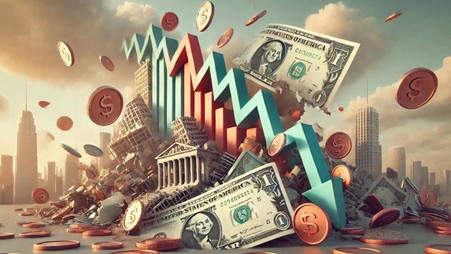
Global economic shifts and the risks of uncertainty
This relationship, characterized by growing competition within a framework of mandatory coordination, reflects tensions in the management of interests, reveals the fragility of the structure upon which the global economic system rests, and suggests that it is on the cusp of transformations that will have a direct impact on both its security and economic systems. The world appears to be at the threshold of a transitional phase in which industrialized and developing economies are seeking greater clarity regarding the shape of the new global economic order, particularly concerning the rules for resource management, energy transition pathways, value chain trends, and the financial and trade frameworks that will define countries’ positions in the evolving international landscape.
Decline in confidence in international frameworks
In the broader global geopolitical landscape, some direct military interventions by major international powers reveal a deeper level of instability in the structure of the international system and a shift in how the instruments of influence are managed and the rules of interaction between states are interpreted. This is evident in cases such as the Russian intervention in Ukraine, which brought back to the forefront the logic of spheres of influence and the use of force outside the framework of collective consensus, as well as in the US military operations in Syria and Iraq, which were carried out based on broad interpretations of the right to self-defense without an explicit UN mandate. These examples have fueled extensive global debates about the consistency of such operations with the principles of the multilateral system, particularly regarding the legitimacy and limits of the use of force outside the framework of a collective mandate.
What makes these developments even more sensitive is the limited practical stance taken by some of the relevant Western powers. They often confine themselves to statements reflecting general reservations without any concrete action, creating the impression that the application of international rules is influenced more by power dynamics than by agreed-upon standards. In a broader analysis, current events can be seen as an extension of a cumulative trend in the international environment over the past few years, characterized by the increasing use of economic and financial pressure tools—ranging from restrictions on access to banking systems to the disruption of vital sectors’ ability to finance—and their transformation into a means of reshaping the choices of targeted countries and influencing their internal balances, as seen in Russia and Venezuela. Furthermore, some powers have resorted to imposing restrictions on movement through air, land, and sea ports, thereby narrowing the communication and trade environments of targeted countries and deepening their economic and social fragility, as in cases such as the Gaza Strip and North Korea. What is new here is not the existence of political disputes, but rather their shift to the level of operations carried out with limited local or regional mandates that do not rise to the level of a comprehensive international mandate, which opens up an escalating debate about legitimacy and the limits of the governing rules.
The impact of shifts in regional behavior
The events unfolding on the international stage and in the Middle East converge not only in terms of legal similarities and factual parallels, but also in the implicit message received by regional powers: the traditional framework that has governed international relations for decades no longer possesses the immunity it was once believed to offer, and the rules of governance are no longer as fixed as they were theoretically presented. As this perception grows, states are increasingly convinced that relying on collective mechanisms may not be sufficient to protect their interests, and that the next phase may necessitate a restructuring of security and economic hierarchies to allow for greater autonomy in risk management.
When these developments are linked to the rising global cost of violence, the scale of displacement exceeding 120 million people, and the marked decline in political models that allow high levels of public participation, it becomes clear that we are facing overlapping layers of structural disturbances that affect the social, political, and institutional conditions within countries, and whose effects are reflected in the way the international system operates.
Global economic security: between power, market confidence, and legitimacy
In this context, global economic security has become increasingly intertwined with three overlapping spheres: the sphere of military power and its instruments of direct influence; the sphere of market confidence, which is affected by the degree of political and institutional stability; and the sphere of legal legitimacy upon which the international system relies to regulate the behavior of actors. In the Arab region, major economic programs aimed at diversifying income sources and building logistical, financial, and technological hubs require a low-risk regional environment, cooperation on energy and maritime routes, and consensus on managing surrounding conflicts.
Some readings also indicate that the general trend in the countries of the region is to place economic stability and digital transformation at the forefront of its priorities, while simultaneously trying to engage in relations with multiple global powers without losing traditional security guarantees.
Possible future scenarios
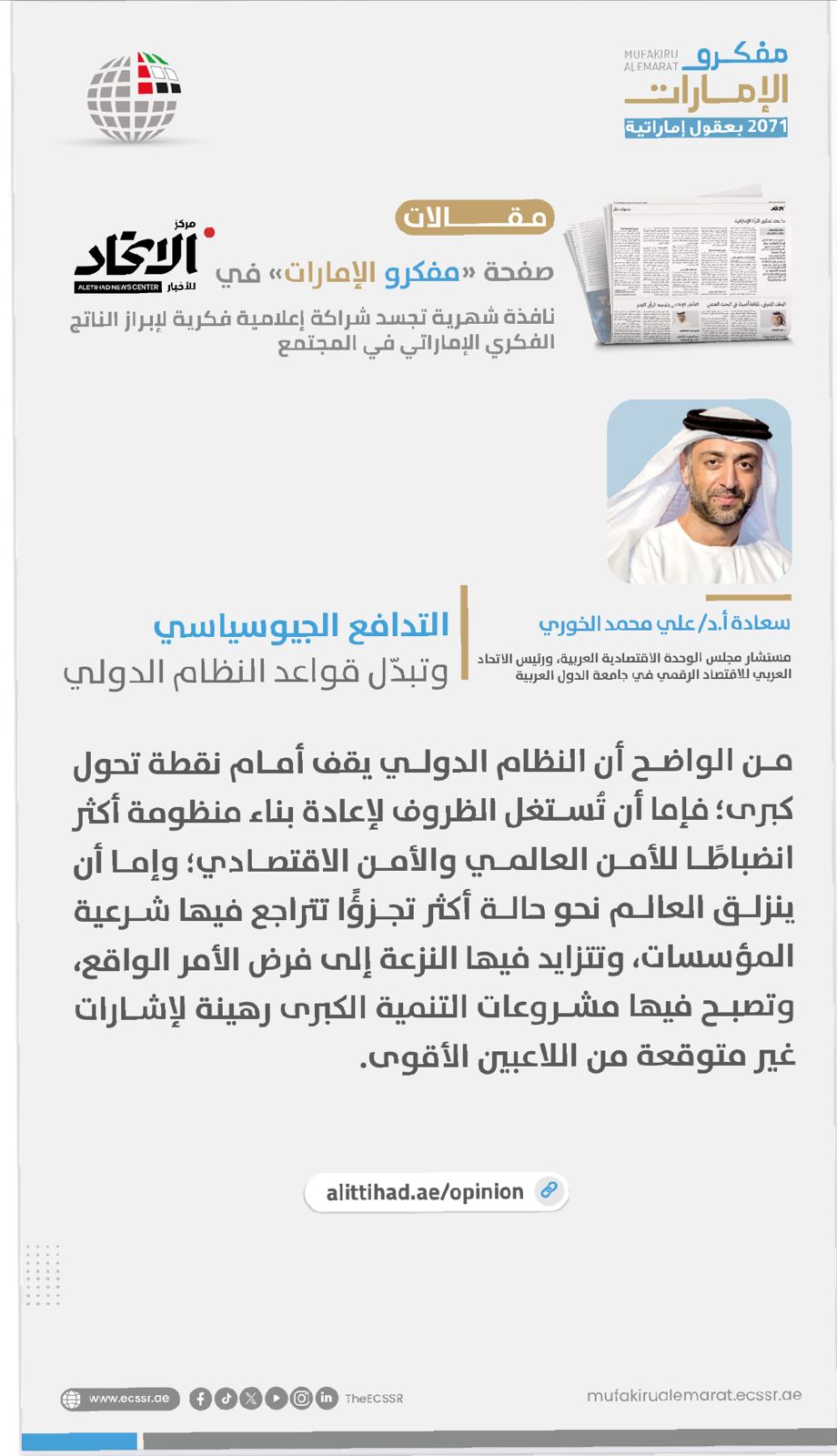
It is clear that the international system is at a major turning point. Either the circumstances will be exploited to rebuild a more disciplined system of global security and economic security, based on stricter restrictions on the use of force outside the framework of the law, the establishment of more regular rules for common governance in energy markets, and the establishment of development partnerships capable of overcoming differences, or the world will slide into a more fragmented state in which the legitimacy of institutions declines, the tendency to impose a fait accompli increases, and major development projects become hostage to unpredictable signals from the most powerful players.
What should be at the forefront of policymakers’ concerns is how to maintain a space for shared understandings that keeps the development process a continuous global project. Given the limited effectiveness of institutions at both the regional and international levels, developing mechanisms for collective institutional action becomes a practical necessity, not an intellectual luxury. If we consider the lessons of history, it becomes clear that unstable transitional phases in the international system are either managed through corrective reviews that support the logic of governance and cooperation, or they are left without institutional oversight, leading to paths that generate new crises, draining the resources of nations and the world for many years.