




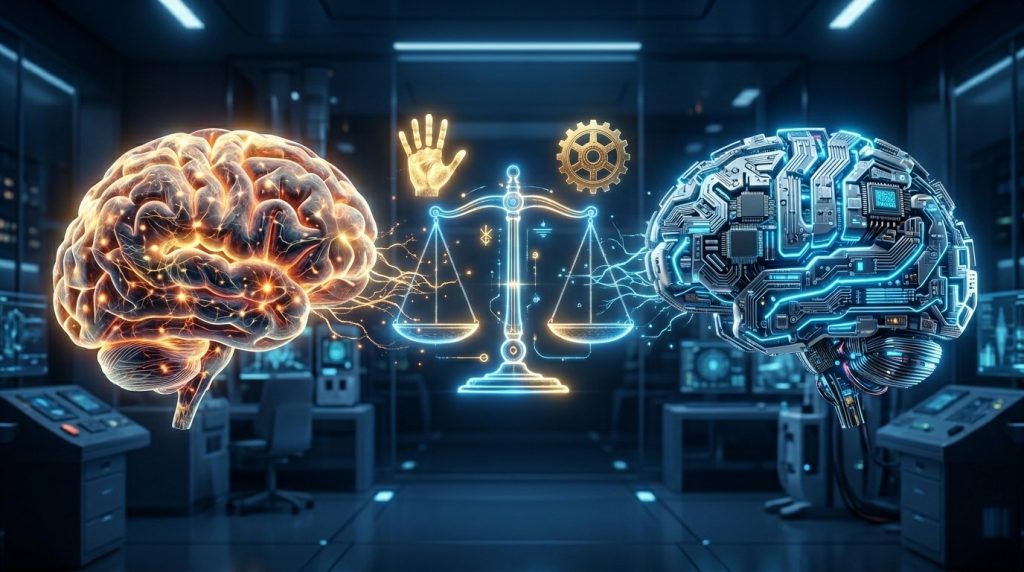
In an era where digital transformation and technological innovation are accelerating at an unprecedented pace, a fundamental question has emerged that concerns economists, policymakers, and business leaders alike: Will robots surpass humans in efficiency and productivity? With the world entering a new phase of automation and artificial intelligence, this question is no longer theoretical; it has become a reality shaping the future of work and the economy.
Introduction: The Rise of Automation in the Modern Economy
Over recent decades, robotics and artificial intelligence technologies have witnessed tremendous development, leading to their integration across various economic sectors, such as:
- Industry
- Services
- Healthcare
- Transportation
This evolution has redefined the concept of work and productivity, as robots have become capable of performing tasks that were once exclusive to humans.
First: What Are Robots in the Economic Context?
Robots refer to automated systems capable of:
- Performing tasks independently
- Interacting with their environment
- Making simple or complex decisions
They include:
- Industrial robots
- Service robots
- Intelligent systems
Second: The Concept of Economic Efficiency
Efficiency in economics means:
- Achieving maximum output at the lowest possible cost
- Improving resource utilization
- Reducing waste
When comparing robots and humans, efficiency is evaluated based on:
- Speed
- Accuracy
- Cost
- Flexibility
- Ability to innovate
Third: Advantages of Robots in the Economy of Tomorrow
1. Speed and Productivity
Robots are characterized by:
- Continuous operation without interruption
- High-speed task execution
- Increased production output
2. Accuracy and Error Reduction
Robots:
- Are not affected by fatigue
- Reduce human error
- Ensure high-quality performance
3. Lower Long-Term Costs
Although the initial investment cost is high:
- Operating costs are relatively low
- Robots do not require salaries or vacations
4. Working in Hazardous Environments
Robots can:
- Operate in mines
- Handle hazardous materials
- Perform tasks under harsh conditions
Fourth: Human Advantages in the Labor Market
1. Creativity and Innovation
Humans excel in:
- Creative thinking
- Problem-solving
- Innovation
2. Emotional Intelligence
Humans are capable of:
- Understanding emotions
- Building relationships
- Social interaction
3. Flexibility and Adaptability
Humans can:
- Adapt to changes
- Learn new skills
- Handle unexpected situations
4. Complex Decision-Making
In situations requiring:
- Critical thinking
- Ethical judgment
Humans remain more efficient.
Fifth: Direct Comparison Between Robots and Humans
| معيار / Criterion | Robots | Humans |
|---|---|---|
| Speed | Very high | Moderate |
| Accuracy | High | Prone to errors |
| Cost | Lower in the long term | Higher |
| Creativity | Limited | High |
| Adaptability | Limited | High |
| Continuous Work | Possible | Not possible |
Sixth: The Most Affected Sectors
1. Industry
The sector is moving toward:
- Smart factories
- Full automation
2. Services
Such as:
- Customer service
- E-commerce
3. Healthcare
Robots are being used in:
- Surgery
- Diagnosis
4. Transportation
Such as:
- Self-driving vehicles
Seventh: Challenges Associated with the Use of Robots
1. Job Losses
Automation may lead to:
- Reduced job opportunities
- Increased unemployment
2. Initial Costs
Implementation requires major investments.
3. Ethical Issues
Including:
- Decision-making responsibility
- Legal accountability
4. Dependence on Technology
This increases risks in the event of technical failures.
Eighth: Are Robots a Replacement for Humans or a Complement?
Studies indicate that:
- Robots will not completely replace humans
- Instead, they will complement human roles
Where:
- Robots handle routine tasks
- Humans focus on creative and strategic tasks
Ninth: The Future of the Labor Market
It is expected that:
- Automation will continue to increase
- New jobs will emerge
- The nature of work will change
Tenth: Strategies for Adapting to This Transformation
1. Skill Development
Learning:
- Digital skills
- Critical thinking
2. Continuous Education
Keeping pace with technological developments.
3. Supporting Innovation
Encouraging creativity and innovation.
4. Human–Machine Collaboration
Achieving integration between humans and technology.
Eleventh: The Role of Governments
1. Regulating the Labor Market
Protecting workers’ rights.
2. Supporting Education
Developing educational curricula.
3. Establishing Smart Policies
Regulating the use of technology.
Twelfth: Who Is More Efficient?
The answer is not absolute; rather, it depends on:
- The type of work
- The nature of the task
Robots are more efficient in:
- Repetitive tasks
- Precision-based work
While humans are more efficient in:
- Creativity
- Human interaction
Conclusion
In the economy of tomorrow, the real question will not be whether robots or humans are superior, but rather how to achieve integration between them to maximize efficiency and productivity. Robots provide unmatched speed and precision, while humans contribute creativity, flexibility, and emotional intelligence.
The future economy will depend on the ability to integrate technology with human capabilities in a way that ensures growth and sustainability. Through investment in education and technology, societies can build a more efficient and equitable economy.
Ultimately, the truth remains that humans are the ones who develop and direct technology, making collaboration between robots and humans the true key to the success of the future economy.
Source: This article is an analytical paper based on automation, robotics, and economics.