



Source: Al-Wafd Newspaper
Prof. Dr. Ali Mohammed Al-Khouri
The global economy is undergoing a transitional phase, one that transcends the boundaries of typical trade competition and transforms into a confrontation and struggle over who will determine the rules of finance and the monetary system. Since the end of World War II, a global financial system has been built upon the centrality of the dollar, which serves as the cornerstone of cross-border trade, central bank reserves, and capital flows. This positioning has allowed the United States to project influence far beyond its economic power, transforming the dollar from a mere medium of exchange into a tool for regulating the entire international system.
The historical roots of building monetary hegemony
The dollar’s dominance was first established with the Bretton Woods Agreement in 1944, and then solidified by the “petrodollar” equation in the 1970s, when oil pricing became exclusively linked to the dollar. With this move, Washington was able to entrench its currency at the heart of the global economic structure, with the dollar accounting for more than half of international trade and nearly 60 percent of central bank reserves. This position formed a power base that granted the United States the ability to finance its domestic deficit without significant pressure and to use the global financial system as a tool of geopolitical influence during times of tension.
Cracks in the existing monetary system
However, the landscape has changed dramatically over the past two decades. The historic levels of US debt have created a crisis of confidence in the structural capacity of the US economy to maintain its monetary strength. With Washington resorting to financial sanctions in several crises, affected countries have gained a strong incentive to reassess their reliance on the dollar, opening the door to widespread moves to realign monetary relations outside the Western orbit. The financial crises that have unfolded since 2008, including the repercussions of the pandemic, have underscored the fragility of a monetary system based on a single center.
The rise of emerging monetary powers
Amid these events, emerging economic powers such as China, India, Russia, and Brazil have risen to prominence, aspiring to a greater role in shaping the rules of the financial game. Beijing, in particular, has moved to expand the use of the yuan in trade settlements within the Belt and Road Initiative, while Moscow has pushed for the use of the ruble and gold in its foreign transactions following waves of sanctions. Meanwhile, discussions within the BRICS bloc have intensified regarding the development of a reserve currency based on a basket of commodities and currencies, in an attempt to create a settlement mechanism less dependent on the vagaries of US policy.
Alternative options: gold and cryptocurrencies
Despite gold maintaining its position as the second most important element in global reserves, divisions within Europe and the lack of a unified monetary policy have prevented it from becoming a competitive alternative global monetary system. Nevertheless, gold remains an indicator of the desire of many countries to find instruments that protect them from the pressures of the current financial system. Meanwhile, central bank digital currencies (CBDCs) are ushering in a new era that could redefine the very nature of money, provided that major powers can integrate them into a global system that allows for interoperability and international transfers that operate harmoniously across different systems.
The geopolitics of money
All these shifts can only be understood as part of a deeper geopolitical confrontation. The United States seeks to protect the dollar’s position as the source of its global power, relying on its military and institutional alliances, while China and Russia are building parallel economic spaces, whether through the Shanghai Cooperation Organisation or the BRICS platform, which is attracting increasing attention from developing countries. Africa and the Middle East are among the first regions to experience these changes, with some countries in these regions beginning to use the yuan and the ruble in their trade.
multipolar monetary system
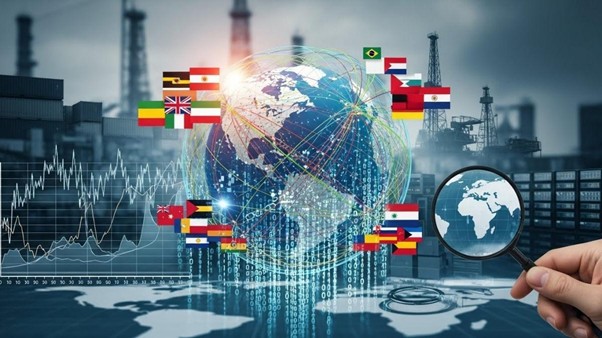
Thus, the landscape is shifting towards a multipolar monetary system, where the dollar’s absolute role diminishes, though it does not disappear. The US currency will remain a cornerstone of the global economy, but it will no longer be the sole player. Rather, it will be part of a broader system in which other currencies, including the yuan, the euro, and perhaps new regional currencies, will compete for influence in international trade, energy corridors, and production chains.
While these shifts open the door to a reshaping of the global financial power map, the real question goes beyond the position of the dollar or the yuan. It concerns the very nature of the monetary system itself and whether the global economy can transition from a model based on a single center dictating its pace to one more aligned with the economic, technological, and demographic realities shaping the 21st century. It also raises the question of whether developing countries will be able to reposition themselves within this system through independent monetary institutions, instead of remaining dependent on these systems.
The critical paradigm of the new century
Amidst these questions, a paradoxical truth emerges: the world is moving toward a financial structure resembling the workings of natural forces when no single element dominates. While the last century was built on the idea of a single currency regulating the overall economic and financial rhythm, the current century is leaning toward a more pluralistic and complex model. Unless this reality is grasped, countries may find themselves facing a series of escalating problems that ultimately result only in the recycling of the old system under new guises.
Perhaps the decisive step today lies in the ability of major powers to shift from a logic of domination to one of balance, and in the capacity of emerging economies to translate their monetary ambitions into robust and resilient financial institutions. What is certain is that history offers few opportunities, and when it does, it favors only those with a vision that recognizes the value of money as stemming from the power that protects and enforces it, not from the paper it is printed on. In a world opening up to unprecedented possibilities, it is clear that the core of the debate will remain tied to the monetary paradigm of the new century, as it will define the shape of economic power in the coming decades and determine the future of existing major financial institutions.