



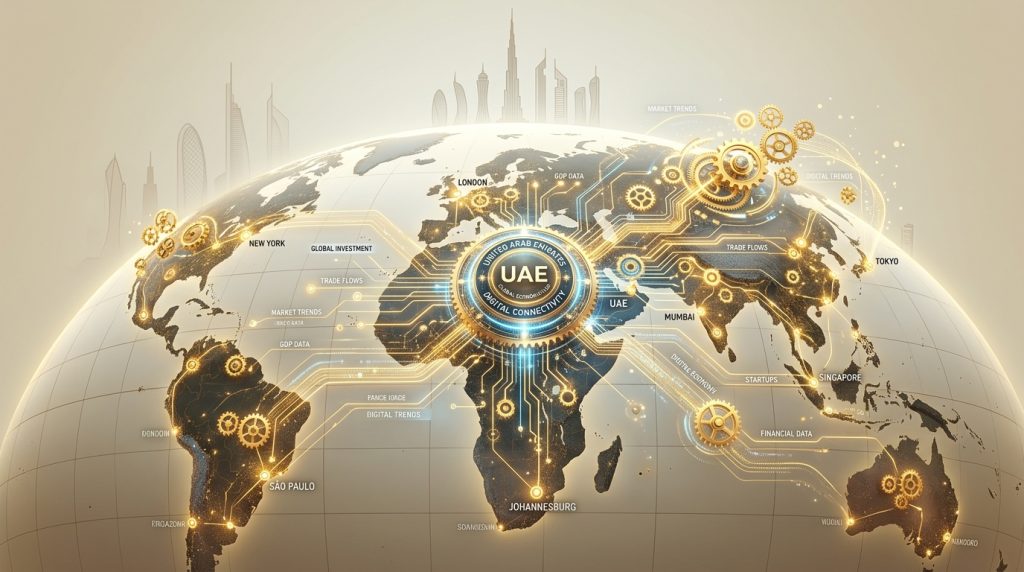
In an exceptional development process, the UAE has made a quantum transition from a resource-based economy to an influential global economic partner, redefining its role on the international economic map. What are the features of this transformation, and what are the pillars on which the UAE has built its new status?
A strategic transformation journey over five decades
The rise of the UAE as a global economic power was not a coincidence, but was the result of a forward-looking vision that adopted economic diversification, investment in knowledge and infrastructure. Since the discovery of oil, the state has quickly invested its revenues in building a multi-sectoral economy that can withstand the volatility of energy markets.
This shift reflects concrete figures: the oil sector’s contribution to GDP has declined from about 55 percent in 1980 to just 17 percent in 2020. In 2025, the contribution of non-oil economic activities exceeded 75% of GDP, the highest percentage in the country’s 54-year history.
This transformation has gone through several phases, starting with relying on oil investments to develop vital sectors, and then moving to a more diversified strategy that included tourism, aviation and financial services, and reaching a focus on the knowledge economy, innovation and advanced technology.
Foundations of the New Economic Power
Today, the UAE’s global economic standing is based on several key pillars, documented by international reports and solid economic indicators.
The UAE is strategically positioned as a gateway to emerging markets, hosting more than 50% of international companies in the Middle East. Dubai and Abu Dhabi are major destinations for global financial institutions. This reflects a remarkable growth in the financial sector, where inflows recorded a record high of $ 45.6 billion in 2024, an increase of 48.7% from the previous year, which put the UAE officially on the list of the top ten destinations to receive foreign direct investment in the world.
Huge foreign investment: The UAE has gone from a future of investment to an active global investor, with its sovereign funds managing more than $3 trillion in assets. Highlights include ADNOC’s €15 billion acquisition of Germany’s Covestro, Mubadala’s $12 billion acquisition of Canadian company CI Financial, and a strategic partnership between the UAE and the United States with a $1.4 trillion investment framework over 10 years that includes artificial intelligence, advanced manufacturing and clean energy. It should also be noted that the UAE is the largest investor in the African continent, with an investment of about $ 200 billion, a third of which is in green energy.
Innovation, technology and the knowledge economy: With the launch of the UAE’s strategy for artificial intelligence and the establishment of the world’s first ministry of artificial intelligence in 2017, the country has placed innovation at the heart of its economy. It invests heavily in future sectors such as ultra-capable data centers, deep technology manufacturing, renewable energy and green hydrogen. Digital activities accounted for 14 per cent of the total Greenfield investment inflows between 2019 and 2024, ahead of the GCC and Middle East and North Africa average.
From Effectiveness to Impact: Radical Reforms that Changed the Game
The UAE’s transition reflects the transition from a mere economic actor to an impact maker, manifested in a package of radical legislative reforms. The complete repeal of the Foreign Direct Investment Law of 2018 and its replacement by amendments to the Federal Commercial Companies Law in 2021 was a decisive turning point, as it abolished the requirement of UAE ownership of the majority in most sectors, and allowed 100% foreign ownership in a wide range of economic activities, with the exception of specific sectors considered strategic such as defense, finance and telecommunications. This shift reflected a shift from a centralized licensing system to a market-based framework, reducing entry barriers and fully integrating the UAE into global value chains and capital.
The reforms also included labor market fixes, including long-term residency permits (golden visas), remote work visas and sponsorship rule changes that have been strengthened agitary and retention of high-skilled human capital.
Challenges and Opportunities: Towards Enhancing Competitiveness
Despite the great successes, the UAE faces regulatory challenges related to the coordination between the UAE, as licensing procedures and administrative practices can vary significantly, creating a complexity for investors working in multiple jurisdictions. Experts point to the importance of enhancing consistency and organizational transparency, and developing a unified national investment strategy that identifies federal priorities, the UAE level and targeted sectors.
The Ministry of Investment was recently established to address these challenges by formulating integrated investment strategies, promoting policy coherence and attracting capital and talent.
The UAE’s Role in the New Global Economy
In a world of rapid geopolitical and economic transformations, the UAE presents itself as a model of a balanced state that combines economic openness and the preservation of national identity, with investment in modern technology and commitment to human values. The UAE is contributing to the redrawing of the global economy by strengthening South-South economic partnerships, supporting energy transformation and sustainability, developing the digital infrastructure of developing countries, and building bridges of cooperation between different civilizations and economies.
The UAE’s journey from an invested country to an influential global economic partner is an inspiring success story in strategic economic development, documented by global economic indicators and reports of international organizations. Through a clear vision and smart investment in human resources and infrastructure, the UAE has been able to establish itself as a global economic pole and a role model in transforming potential into tangible achievements, while maintaining a positive humanitarian footprint in the international community.
Sources
Organisation for Economic Co-operation and Development (OECD) – “Investment Policy Perspectives in the United Arab Emirates” (May 2026)
Khaleej Times – “Capital corridors: How the UAE is redrawing the global map for investment” (December 2025)
Economy Middle East – “UAE targets $65 billion annual FDI inflows by 2031” (February 2026)
UAQ Free Trade Zone – “UAE ranks among the world’s fastest-growing economies in 2025”