



Cairo
Source: Al-Wafd Newspaper
Prof. Dr. Ali MOhammed Al-Khouri
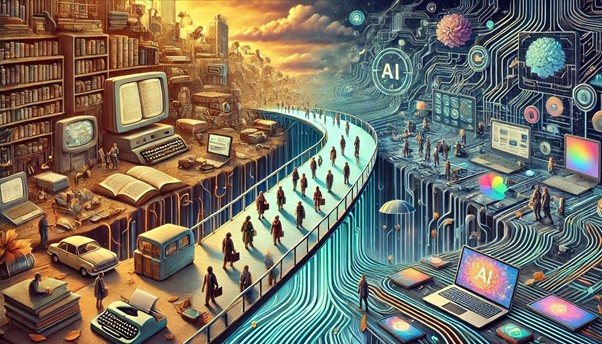
Technological progress at any point in history has never been an independent outcome of the evolution of thought, nor has thought been able to transcend its limitations without new tools that expand its capacity for observation, experimentation, and production. Printing not only transformed the means of disseminating knowledge but also altered the status of science in society, restructured education, and broadened participation in the production of ideas. Then came the Industrial Revolution, which transformed the very concept of work and production, thereby transforming economic and social systems. What is happening today in the fields of artificial intelligence, computing, and communications is an extension of this trajectory; it represents a new stage in the evolution of knowledge itself, with its implications for the economy, management, education, and culture.
Therefore, it is difficult to separate technological development from intellectual development. Technology does not arise in a vacuum; rather, it is born from a scientific environment that allows for experimentation, critique, and the exchange of knowledge. It then returns to influence this environment, changing methods of learning, research, work, and communication. Every technological advancement raises new intellectual questions concerning its use, effects, and limitations, just as every intellectual shift creates new needs that drive the development of different tools and technologies. The relationship between the two is not one of dependency, but rather a continuous, cumulative, and reciprocal one, as long as human knowledge expands.

This interconnectedness has transformed the nature of the global economy. Economic power is no longer measured solely by the size of natural resources or productive capacity, but also by a society’s ability to generate knowledge and translate it into practical applications. Universities, research centers, and technology companies have become integral to the economic structure because they produce a resource whose value increases with its use, unlike traditional resources that diminish with consumption. Consequently, scientific research, intellectual property, and innovation have risen in importance, becoming essential elements in international competition.
Technology’s impact extends beyond the economy, permeating our very way of thinking. The digital revolution has transformed our understanding of access to knowledge. The challenge is no longer simply acquiring information, but rather analyzing, verifying, and contextualizing it within its scientific and social frameworks. Furthermore, artificial intelligence applications have raised new questions about the nature of work, the limits of responsibility, the future of education, privacy, and the ethics of decision-making. These issues cannot be addressed by technology alone; they require the engagement of philosophy, law, social sciences, and economics, underscoring the inseparable link between scientific progress and intellectual development.

Hence the importance of intellectual investment as an investment in the capacity to produce knowledge, not merely consume it. This investment is not limited to spending on education or increasing the number of universities, but also includes building an environment that encourages free thinking, systematic research, scientific dialogue, the exchange of expertise, and linking knowledge to the needs of society and the economy. Institutions that generate new ideas are not established by administrative decree, but rather develop through a long accumulation of quality education, institutional stability, respect for scientific research, and encouragement of individual initiative.
Therefore, the countries leading the knowledge economy did not achieve their status solely because of their advanced technologies, but because they invested for decades in human capital before machinery. They linked education with scientific research, and research with production, then provided companies and universities with an environment that allowed them to transform ideas into products and services. Laboratories, business incubators, venture capital funds, and intellectual property protection systems became interconnected parts within a single system, rather than separate institutions each performing an independent function.

The Arab world has witnessed a clear expansion in higher education, with a rise in the number of universities and researchers, and a growing interest in the digital economy and modern technologies. However, this expansion has not translated into a similarly broad base for knowledge production. The relationship between universities and the productive sector remains limited in many areas, and reliance on imported technology continues to outweigh the capacity for local development. Consequently, the contribution of scientific research to economic activity remains below the region’s potential.
This gap stems less from a lack of expertise than from the nature of the system in which it operates. Universities produce knowledge that doesn’t always find its way into industry, and companies seek quick solutions from foreign markets, while the institutions responsible for transferring knowledge between the two remain limited in their impact. Consequently, much scientific work, despite its inherent value, loses its opportunity to be transformed into a new product, company, or technology.
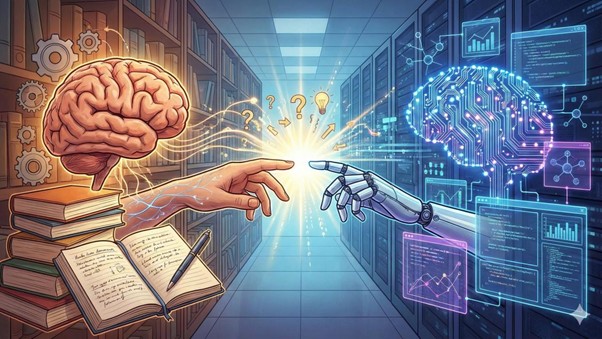
This reality necessitates a restructuring of the relationship between education and the economy, so that scientific research becomes an integral part of the production process, not a separate activity. This requires encouraging companies to invest in research and development, expanding the role of innovation centers, providing funding mechanisms for technology projects, and enabling researchers to participate in establishing companies and bringing their research findings to market. It also requires developing legislation that protects intellectual property, as this gives innovation economic value and encourages investment.
The Arab world possesses genuine opportunities to build a more knowledge-based economy, not only because of its financial resources but also because of its demographics. A high youth population, widespread use of digital technologies, and increasing access to higher education are factors that can become a foundation for innovation if coupled with long-term policies that prioritize knowledge production. Furthermore, the challenges facing the region in the areas of water, energy, food, health, and the environment represent fertile ground for developing local technological solutions that could, over time, evolve into industries capable of competing internationally.

This transformation does not require severing ties with global experiences, but rather leveraging them. Technology is transferred through collaboration, partnerships, training, and investment, but its true value emerges when it becomes the foundation for building local expertise capable of development and innovation. An economy that consumes technology remains dependent on its producers, while an economy that learns from it and then develops it gradually expands its scientific and productive independence.
Discussions about the future in the Arab world should not begin with technology itself, but rather with building the capacity to produce the intellectual framework that drives it. Every major technological transformation has been preceded by a scientific and cultural environment that allowed for the emergence of new ideas and then provided the institutions to disseminate them within society and the economy. What the Arab world needs today is to build a system that makes knowledge production a continuous process and makes investment in human capital the foundation for investment in technology. Then, technological development will become a natural consequence of intellectual development, and intellectual investment will become part of a long-term economic project, not a temporary program imposed by the shifts of the times.