




Source: Al-Wafd Newspaper
Prof. Dr. Ali Mohammed Al-Khouri
Today, climate change intersects with the economic, political, and social crises in the Arab world, placing the region on the front lines of rapidly evolving environmental challenges and phenomena. The gravity of the situation lies in the fact that climate change has become the force reshaping the region’s demographic and economic landscape, compelling decision-makers to adopt a long-term strategic approach, especially given the interconnectedness of resources, water, energy, and governance within frameworks where these elements are difficult to separate.
Rising temperatures have become a constant feature in the Arab Gulf states and a number of countries in the Middle East and North Africa, as they rise at a rate exceeding the global average, casting a shadow on public health, the future of industry and services, and the ability of agriculture to survive in environments that are rapidly heading towards unprecedented levels of drought and heat.
The situation takes on a more confusing dimension in light of the water scarcity that is looming at its maximum limits, as the Arab region is one of the regions in the world that suffers most from water scarcity, a scarcity that is likely to worsen with population growth and the continued deterioration of ecosystems, making the issue of water a fundamental focus in Arab national security discussions during the coming decades.
Potential disasters are advancing at a remarkable pace, especially the risk of rising sea levels that threatens the Nile Delta and coastal cities in Egypt, Tunisia, Morocco and the Gulf States with geographical disturbances that may redraw population density maps, as well as the growing waves of desertification that are choking agricultural lands in the Levant and desert regions, and putting the foundations of the rural economy on the front line with the risk of collapse.
Given these changes, the Arab region appears to be slipping into a murky space open to diverse scenarios. The most bleak path lies in continuing with the traditional approach without genuine structural reforms, which could lead to greater social and economic crises, and fuel waves of internal and external migration that escalate as resources dwindle, while the likelihood of fierce competition for water and land increases.
The limited action scenario, adopted by some governments through partial and uncoordinated environmental initiatives at the regional level, provides modest gains in water and energy management, but does not change the structural reality of weak agricultural production systems and the risks resulting from pressure on infrastructure in urban areas.
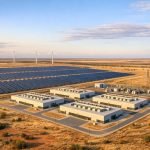
In contrast, the optimistic scenario presents a more mature vision based on a broad Arab shift towards a low-carbon economy, relying on major solar and wind energy projects, investments in smart agriculture and water recycling, and the building of a scientific knowledge base capable of supporting this trend.
Moving to this scenario requires a shared regional vision that goes beyond piecemeal approaches, through the establishment of Arab mechanisms for climate cooperation, the development of frameworks for future urban planning, the development of strategies to protect coasts, the expansion of the role of environmental education, and the reformulation of development policies so that they are able to respond to climate changes and their links to the global economy.
The importance of reconsidering resource management patterns, developing advanced water desalination technologies, and building cities capable of withstanding extreme climatic phenomena is confirmed, along with establishing the concept of community participation as a fundamental element in creating a new culture that is more aware of the requirements of the global environmental reality.
At this historic moment, the region appears to be facing two pivotal choices: either to succumb to the downward spiral and accept being led into widespread economic and social turmoil, or to take a proactive stance that places it at the forefront of emerging nations that are reshaping the course of development through innovation and long-term planning.
Despite its pressing environmental nature, climate change reveals the need for a new Arab development model that balances economic considerations, environmental requirements, and societal needs. As the horizon of future transformations widens, the question arises as to whether the Arab world can turn the climate crisis into an opportunity to build a new and more influential role in the international system, rather than remaining trapped within the circle of intensifying pressures surrounding it.
Climate as a basis for building a new Arab economic model
Policymakers today find themselves in a position that requires them to redefine their countries’ position in a world where certainties are declining and power maps are being reshaped, and to adopt a vision that considers climate the cornerstone of a new economic system capable of moving beyond the logic of managing challenges and adapting to creating new solutions and development models.
But achieving this will not be possible with individual efforts or scattered initiatives; dealing with the climate challenge requires joint Arab action that puts the collective interest at the forefront of priorities, and transforms scattered capabilities into a force capable of creating a different reality.