



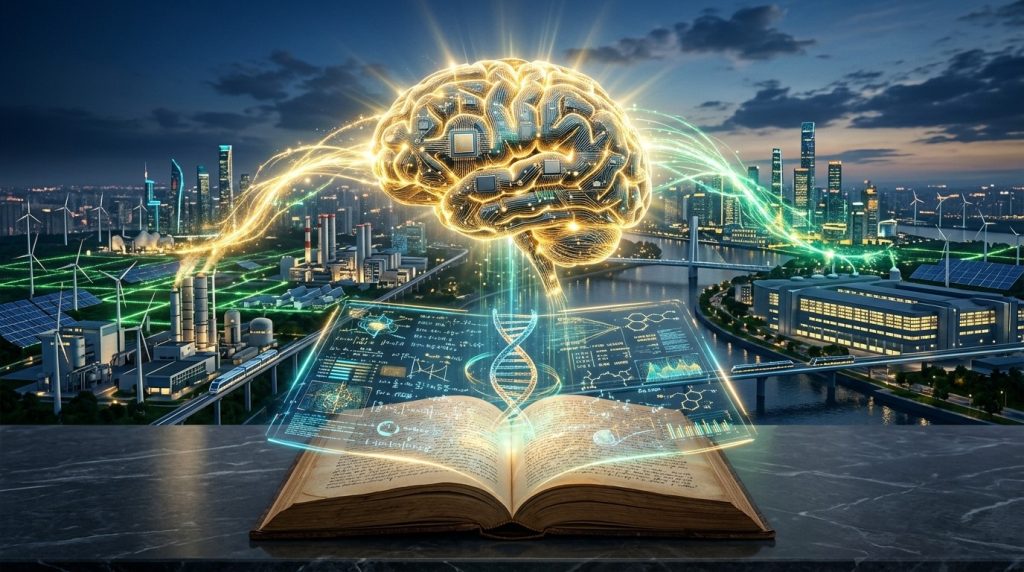
Education and scientific research are considered among the most important pillars of the knowledge economy. In the modern era, economic wealth no longer depends solely on natural resources or physical capital; instead, it increasingly relies on human and intellectual capital. As a result, improving education and strengthening scientific research have become central strategies adopted by countries seeking to achieve sustainable economic development.
The knowledge economy is based on a fundamental idea: knowledge can be transformed into economic power when it is produced and utilized effectively. This process begins primarily within the educational system, where individuals are equipped with the skills and knowledge necessary to participate in the knowledge economy.
Education in the Age of Knowledge
In the past, education focused mainly on transferring information from teachers to students. In the age of the knowledge economy, however, the primary objective of education has become the development of critical thinking, creativity, and innovation.
The skills required by the modern economy are no longer limited to theoretical knowledge; they also include the ability to analyze complex problems, work collaboratively, and use modern technologies effectively.
For this reason, many countries have begun redesigning their educational curricula to emphasize science, technology, engineering, and mathematics (STEM), which form the scientific foundation of the knowledge economy.
Lifelong learning has also become an essential part of modern life, as the skills required in labor markets continue to evolve rapidly due to technological advancement.
Universities as Centers of Knowledge Production
Universities play a central role in the knowledge economy, not only as educational institutions but also as centers for knowledge production and innovation.
Many of the world’s major scientific and technological breakthroughs originated within universities and research centers. Universities also contribute to training the highly skilled workforce needed by advanced industries.
However, for universities to perform this role effectively, strong connections must exist between academic institutions and the industrial and technological sectors. Cooperation between universities and companies helps transform scientific research into practical economic applications.
Scientific Research and Economic Development
Scientific research represents the main driver of innovation in the modern economy. Countries that invest heavily in scientific research are generally more capable of developing technology and achieving economic progress.
Expenditure on research and development (R&D) is considered one of the key indicators used to measure countries’ advancement within the knowledge economy. In developed countries, spending on scientific research accounts for a significant percentage of gross domestic product (GDP).
Such investment in scientific research contributes to the development of new industries and increases economic productivity.
Challenges Facing Education and Scientific Research
Despite the importance of education and scientific research in the knowledge economy, many countries still face major challenges in these areas.
Among the most significant challenges are insufficient funding allocated to scientific research and the gap between educational outcomes and labor market needs.
In addition, the migration of skilled professionals and researchers represents another major issue affecting countries’ ability to build a strong knowledge economy.
Conclusion
Building a knowledge-based economy requires the development of advanced educational systems and the strengthening of scientific research. Knowledge has become the most valuable resource in the modern economy, and investing in education and scientific research represents the true investment in the future of nations.
Source: This article is an analytical/introductory article based on knowledge economy literature, UNESCO, the World Bank, and studies by the Union authored by Prof. Dr. Ali Mohammed Al Khouri.