



Hangzhou, China
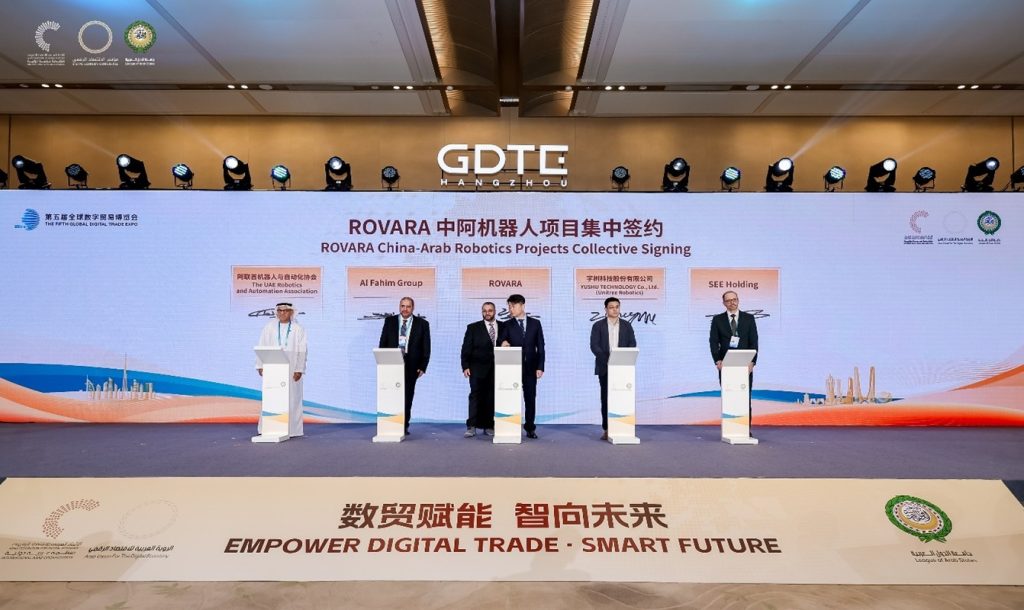
The first China-Arab Digital Dialogue in Hangzhou witnessed the signing of a package of memoranda of understanding and cooperation related to the ROVARA project, which was recently announced by the Arab Federation for Digital Economy . This step aims to build a practical system for cooperation between Arab and Chinese companies and institutions in the field of robotics and embodied artificial intelligence, and to link advanced Chinese technology with opportunities for use and investment in Arab markets.
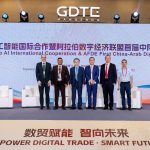
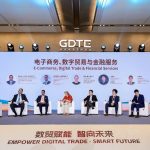
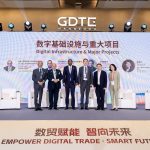
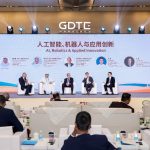
The signing ceremony took place as part of the announcement of the main outputs of the forum, which was organized by the Arab Federation for Digital Economy in conjunction with the Global Digital Trade Fair GDTE 2026 , with the participation of institutions and companies working in robotics manufacturing, investment, urban development and advanced technology applications.
ROVARA represents a model aimed at developing an integrated market for robotics applications, based on cooperation with a number of manufacturers and solution developers, and working to link these solutions to the needs of companies, institutions and projects in the Arab region, in order to develop robotic fleets that are operational and expandable in multiple sectors.
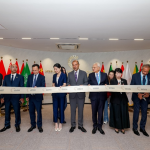
The ROVARA China–Arab Robotics Project ceremony witnessed a collective signing in which Mr. Tang Tang , the co-founder of ROVARA , Mr. Ahmed Abdul Jalil Al Fahim, Chairman of the Board of Directors of Al Fahim Group, Dr. Saeed Al Dhaheri, President of the Emirates Robotics and Automation Association, Mr. Zhang Min , Vice President of YUSHU Technology “Unitree Robotics” , and Dr. Fadi Jamal Al Fares, CEO of SEE Environmental Holdings , participated .
The diversity of the participating entities reflects the nature of the project itself; it combines a robotics development and operation platform, a Chinese technology factory, specialized expertise in robotics and automation, and partners from the business, development, and sustainable environment sectors , allowing for a transition from showcasing technologies to testing their actual applications in real sectors and work sites.
The approach focuses on developing applicable use cases in Arab markets, studying robots-as-a-service operating models, building the necessary technical capabilities for operation, maintenance and integration, along with knowledge transfer and training, and expanding in the future opportunities for local assembly, manufacturing and development whenever the market size proves its feasibility.
This move comes at a time when the Chinese robotics sector is witnessing rapid development, especially in service and industrial robots, humanoid robots and embodied artificial intelligence, which opens up an opportunity for Arab markets to move from simply importing equipment to building deeper commercial, investment and technological partnerships with Chinese companies .
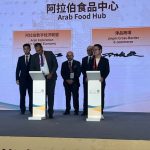
In a complementary investment track to this system, Al Fahim Group and Daode Investment signed a memorandum of understanding related to the China–Arab Digital Innovation Industry Fund initiative . It was signed by Ahmed Abdul Jalil Al Fahim on behalf of the group and Wu Fei, Chairman of Daode Investment.
This step aims to explore opportunities for building investment and financing partnerships in new technology sectors, primarily robotics, digital technologies and new energy, thus providing a financial and investment dimension that complements industrial and technological cooperation.
These understandings are integrated into a single approach based on combining Chinese technology, Arab expertise, market and partners, financing and investment , so that cooperation is not limited to supplying products or signing general memoranda, but rather paves the way for developing projects that can be tested and commercially expanded in the region.
This comes as part of the Arab Federation for Digital Economy’s efforts to develop practical channels for cooperation with China in the digital economy and advanced technologies, and to transform dialogues and institutional relations into opportunities that bring together manufacturers, investors, companies and technology users in projects with clear economic applications.