


Abu Dhabi
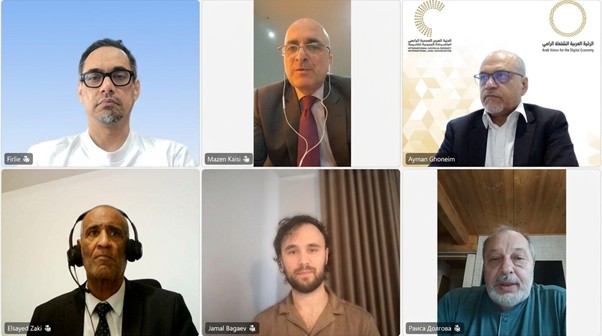
The Arab Federation for Digital Economy held a coordination meeting via video conference, with the participation of representatives from the Alliance for the Development and Heritage of Science, Culture and Education in the BRICS countries (ANCO BRICS) and the Indonesian Chamber of Commerce and Industry, to discuss opportunities for economic and technological cooperation, and to explore new areas of partnership between the business sectors in the Arab world, Indonesia and the BRICS countries.
The meeting began with a presentation by Dr. Ayman Ghoneim, Assistant Secretary-General of the Federation, who provided an overview of the Federation’s role and its work as an Arab non-governmental organization operating under the umbrella of the League of Arab States. He highlighted its most prominent initiatives and projects, including the Arab Food Hub platform, which facilitates cross-border trade in the food sector; the Masarat digital learning platform; and the Madar platform, which aims to connect Arab companies with international partners and open up opportunities for cooperation in investment and technology transfer. He also discussed the Federation’s efforts in developing digital policies and supporting artificial intelligence applications and cybersecurity.
Regarding academic and educational cooperation, the meeting reviewed the “Masarat” platform (EduforArab.org), a digital environment that brings together universities, educational institutions, and training centers, enabling them to showcase their programs, courses, and curricula to students. Participants discussed opportunities to expand the platform’s network and attract new universities and educational institutions. They also considered a proposal to invite representatives from the ANCO BRICS Alliance and the BRICS Network to participate in the annual conference of Arab universities. This would allow academic institutions to learn about the alliance and explore opportunities for collaboration and joining its network.
For his part, Professor Dr. Oleg Dolgov, representative of the ANCO BRICS Alliance, reviewed the nature of the alliance and its activities in building bridges of international communication. He explained that its efforts focus on attracting new members and partners through the BRICS network, connecting international academies and scientific institutions, including the International Academy of Basic Sciences, as well as engaging with government agencies and museums to expand areas of partnership and cooperation at the international level. He also clarified that the alliance’s membership includes universities, non-governmental organizations, and the business sector.
In the same context, Mr. Faili Jarindoto, representative of the Indonesian Chamber of Commerce and Industry, reviewed the Chamber’s role in supporting the digital ecosystem and the business and investment environment in Indonesia, pointing to opportunities for cooperation with the Federation in a number of areas, including facilitating companies’ entry into markets, linking them with local partners, developing capacity-building and talent training programs, as well as expanding trade in the halal food sector.
The meeting concluded by emphasizing the importance of continued communication and information exchange regarding upcoming economic exhibitions and events, and exploring opportunities to organize joint participations and delegations, which would open new horizons for economic and technological cooperation between the Arab world, Indonesia, and the BRICS countries.