



Mufakiru Alemarat
Prof. Dr. Ali Mohammed Al-Khouri
It is no longer possible to gauge the stability of economies solely through growth indicators or market price levels, as these indicators reflect only a limited aspect of the true picture and overlook a different reality that cannot be fully understood without analyzing the internal structure of its components. The contemporary economic system, as international political economy studies indicate, has transcended its traditional scope as a system for managing money, production, and the distribution of goods and services. It has transformed into a system more focused on risk management and its redistribution within the economic system, often in a subtle way. The question here is not the magnitude of the risks facing the global economy, but rather how these risks are generated within the system, which has become a direct influence on shaping the structure and balances of societies.
Financial imbalances between debt levels and economic growth
This can be better understood by examining how the modern economic system functions today . With the increased use of financial instruments, greater market interdependence, and rising debt levels, the system has become more resilient to short-term shocks. However, it has also become increasingly dependent on mechanisms that focus on mitigating the effects of crises rather than addressing them and finding comprehensive solutions. This means that crises do not necessarily disappear; rather, they are transferred from one place to another within the economy, later reappearing in different forms.
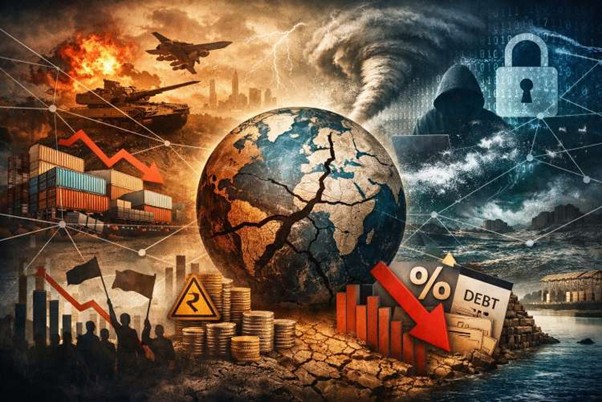
This is clearly evident when examining global debt levels. Data from the International Monetary Fund reveals that total global public and private debt has reached new record highs, exceeding 235% of the global economy, amounting to approximately $251 trillion. These figures clearly demonstrate that the size of financial obligations is growing at a faster pace than economies’ ability to generate real value. This points to an imbalance not only related to the size of the debt but also to the nature of the relationship between fiscal expansion and the real economy.
Herein lies the fundamental problem and the serious questions about the sustainability of this path; the wider the gap between what countries owe and their financial obligations, and what they actually produce, the greater the likelihood of pressures that may, over time, turn into crises that retest the balance of economic systems and their ability to withstand challenges.
Concurrently, global economic growth remains limited—around 3.2%, with some estimates suggesting a possible decline to 2.6%—revealing a clear divergence between debt and production trends. This divergence cannot be understood or explained by traditional business cycle frameworks, as its very nature indicates that the problem lies in the structure of the economic system itself and its formation, not merely in its outward manifestations.

Transfer of risks within the global economy
Examining the structure of this system reveals that it relies on a set of mechanisms that allow it to maintain a degree of apparent stability, despite the continuous accumulation of internal risks that only surface when it is subjected to shocks. These mechanisms constitute what can be described as a “risk-postponement economy,” where crises are dealt with by transferring and redistributing their effects, rather than addressing them directly.
This structure begins with a point related to how value is determined in the economy. Previously, asset value was measured according to clear and verifiable criteria. Today, however, with the increasing complexity of financial assets and the expansion of non-traditional markets, a growing portion of these assets has become difficult to value or has unclear ownership, particularly in private markets, cross-border financial structures, and environments lacking sufficient transparency. This shift not only affects market efficiency but also impacts the state’s ability to understand the movement of resources within the economy.
As information about assets and their movement becomes less transparent, the state’s ability to collect revenue and regulate economic activity diminishes, thus limiting the effectiveness of national fiscal policies. This situation creates greater opportunities for specific groups to operate outside the bounds of oversight, gradually leading to an increased concentration of financial resources in their hands. These regulatory imbalances then have a direct impact on how resources and opportunities are distributed within the economy.
The effects of this shift extend beyond the level of monetary value; they also impact how monetary policies, particularly interest rates, affect the economy. With rising debt levels, especially among households—exceeding 70% of GDP in some economies—any increase in interest rates directly leads to a decline in income and spending, and an increase in the cost of living. Instead of remaining a tool for maintaining economic equilibrium, these policies become a means of transferring risk from the financial system to individuals.
Herein lies one of the most prominent features of the contemporary financial system; instead of distributing risks in a balanced manner among the different parties, the current structure tends to place the largest share of these risks on borrowers, especially households; which makes economic stability dependent on the ability of this group to absorb shocks.
At the national level, this phenomenon takes on a more complex dimension, especially given that global public debt reached approximately $111 trillion in 2025, roughly equivalent to the size of the global economy itself. World Bank data indicates that many developing countries are now repaying more debt than they receive in new financing, and that low- and middle-income countries recorded net financial outflows of around $741 billion between 2022 and 2024. This means that the financial resources of borrowing countries are flowing abroad instead of being used to support domestic growth. Taken together, these figures reflect a shift in the role of debt, which has become a burden that reduces the ability of developing countries to invest in key sectors, keeps them in a continuous cycle of borrowing and repayment, and limits their room for maneuver in addressing crises and absorbing shocks.

When these elements are taken together, it becomes clear that the stability of the global economic system is not based on true equilibrium, but rather on a series of mechanisms that redistribute risks across the system. This explains how the economy can appear stable on the surface, despite the continued accumulation of imbalances within it. Therefore, the real challenge lies not in the absence of solutions, but in the very nature of the system itself, which allows this cycle to persist.
However, partial solutions will not be enough to overcome this situation; the foundations upon which the global economic system is based must be reconsidered. Therefore, dealing with this phenomenon requires moving from focusing on crisis management to understanding how it arises within the system.
Priorities for reforming the structure of the global economic system
Based on current trends, as confirmed by international institutions, the most prominent recommendations do not revolve around “more intervention,” but rather around three specific tools. The first of these recommendations relates to rebuilding the information infrastructure of markets through stricter requirements for disclosing the true ownership of cross-border assets and structures, expanding the exchange of financial information between authorities, and enhancing transparency in international payments and transfers. Countries will not be able to manage their economies, protect their revenue bases, or accurately assess risk if financial assets move outside the scope of official monitoring and regulations.

The second recommendation is to halt the automatic transfer of risk to households. Demand stability cannot continue to depend on households’ ability to absorb the impact of high interest rates and a rising cost of living. A more consistent approach, based on the lessons of recent years, is to redesign housing and consumer credit markets to distribute risk more equitably between lenders and borrowers, while expanding the use of macroprudential tools to high-risk financing and the non-bank financial sector. This is preferable to leaving the burden of adjustment, in each cycle, to fall on household income and domestic spending. An economy that maintains stability by weakening households merely postpones the crisis, but at a higher cost later on.
The third recommendation concerns sovereign debt management, an area where the most apparent contradiction between the global nature of markets and the limitations of national decision-making is evident. What is needed here is a clear and rapid path for debt restructuring, including shorter, binding timeframes and a higher level of coordination among lenders—whether governments and international institutions, or banks and investors—along with the provision of temporary financing mechanisms to help governments continue spending, thus preventing the debt problem from escalating into a protracted economic crisis. When developing countries are forced to repay more than they receive in new financing, debt becomes a means of draining resources from weaker economies precisely when their need for investment is greatest.
Future prospects for economic reform paths
However, the core of the issue remains as much political as it is economic. The problem does not lie in knowing what to do, as most solutions are not disputed in their general outlines. Rather, their implementation is hampered by conflicting interests and an imbalance of power between creditors and debtors, and between the countries that set the rules of global finance and those that operate under them. Therefore, the real question is not whether technical alternatives are available, but whether the political will exists to transcend short-term calculations.
The implications of this extend beyond the economic sphere; they reach into the very nature of the global social structure that is taking shape amidst these transformations. While economic history suggests that major crises are often the result of accumulated, often unseen, imbalances, what we are witnessing today may reflect the approaching moment of transformation. This transformation will necessitate a readjustment of the foundations and rules upon which the economic system rests, before crises impose it at a higher cost and with less manageability and containment.