



Source: Al-Wafd Newspaper
Prof. Dr. Ali Mohammed Al-Khouri
The relationship between financial markets, economic powers, and modern technology is intricate in shaping the international system. This relationship resembles a complex structure where the balance of power is distributed among those who can mobilize capital, control the flow of technological innovation, and formulate the standards governing the movement of money and data. Consequently, financial markets are no longer merely platforms for asset exchange; they have become arenas where national power is measured and economic resilience is tested. Credit ratings and investment trends now clearly reflect a country’s economic standing and its position within the global financial system.
Through this transformation, economic forces have emerged that transcend traditional state boundaries, including major powers, multinational corporations, and global financial institutions, as centers of influence capable of shaping the course of the international economy. These entities have acquired the ability to shape the policies of other economies through tools that appear technical or regulatory, but which, in essence, carry clear political dimensions.
These powers are keen to utilize their currencies and financial markets to attract liquidity at times, or to redirect it at others, while giant corporations leverage their global reach to impose economic conditions on smaller countries, relying on their weight within the international system of influence. Money and technology have become essential elements in how countries manage their positions and power within the global system, particularly with regard to supply chains, technology, and digital platforms. International institutions continue to link loans and aid to structural reforms that infringe upon economic independence, making the global economy an arena of influence where power is exercised in complex and multifaceted ways.
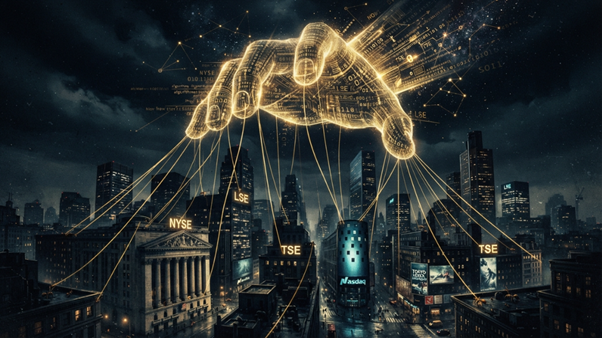
Technology is advancing, adding another layer of overlap between economics and power. Digitalization and artificial intelligence have reshaped the nature of financial transactions, with the unprecedented speed of money transfers becoming part of the equation of influence and power. Economic dominance is now contingent on controlling the flow of money in real time. Digital currencies, whether issued by central banks or decentralized platforms, have risen to pose a direct challenge to traditional monetary structures by diminishing the role of intermediaries, altering the patterns of control over money issuance, and creating financial spaces that operate outside familiar regulatory boundaries. With this shift, the balance of monetary power is beginning to tilt toward those who possess the technological capacity to manage new digital systems, rather than those who monopolize traditional monetary instruments.
At the same time, big data has become a raw material of power, with advanced analytics used to guide investment decisions and reshape risk management methods, while algorithms have moved into the role of the invisible force determining market fate and direction. With the expansion of digitalization, major technology companies have become as much political players as economic ones, controlling information flows and influencing consumer and economic behavior globally, while cybersecurity has become an arena of strategic competition no less important than military competition.
The challenges facing the Global South and the Arab world are particularly evident in this context, as developing countries suffer from a weak negotiating position in shaping the rules of the new financial order. Political instability, the vulnerability of markets to sharp fluctuations during every crisis, and their dependence on technology managed from outside their borders all diminish their ability to establish genuine digital and economic sovereignty. Furthermore, local digital and financial infrastructures often remain hostage to the decisions of external corporations or centers of power, making the exercise of authority over them contingent on global rather than local will.
In this context, digital financial technology constitutes an arena that combines soft and hard power. Power is exercised through controlling investment trends, imposing financial sanctions, and directing the flow of global capital and liquidity. Acquiring strategic companies or controlling the digital infrastructure of major powers has also provided them with greater scope for transnational influence. Concurrently, the ability of actors to monitor and control has increased thanks to technological advancements, making the contemporary struggle for influence largely a matter of who owns the platforms, the data, and the ability to protect their cyberspace.
These interactions clearly demonstrate that the relationship between financial markets, economic actors, and technology has established a new global power structure. Markets determine the position of nations, and major powers use these positions to realign influence, while technology reshapes the rules of the game, creating maps of influence that were impossible a decade ago. The exercise of power in today’s world is no longer tied to weapons or material wealth, but rather to the ability to manipulate data and algorithms, control the flow of money, and impose the standards that govern the global digital economy.
These transformations demonstrate that the changes the world is witnessing are no longer limited to shifts in the tools of power and influence, but are undergoing a process of redefining the very essence and implications of power. The influence of states and major corporations is now linked to their ability to anticipate developments and shape the future by integrating technology, economics, and politics into a unified system with a new logic. With this shift, the international system is preparing for a phase in which centers of influence will be rearranged according to each entity’s digital and intellectual capabilities, and its ability to leverage data, platforms, and financial and technological infrastructure.
What seems clear is that the world is moving towards a different structure of power balances and spheres of influence, in which traditional methods are declining in favor of a more complex pattern, in which the rules of the global game are being reformulated so that data, algorithms, and digital resources become crucial elements in determining the position of each country and each entity within the new international structure.