




The Arab Federation for Digital Economy launches the fifth edition of the index during “Seamless Middle East 2026” in Dubai.
Dubai – September 22, 2026
The United Arab Emirates topped the results of the “Arab Digital Economy Index 2026”, the fifth edition of which was launched by the Arab Federation for Digital Economy during the “Seamless Middle East 2026” conference and exhibition in Dubai, under the title “Digital Sovereignty in the Arab Region”.
This new edition comes at a time when the nature of the digital economy is changing globally. The issue is no longer simply about internet penetration or the digitization of services, but rather about a country’s ability to manage its data, digital infrastructure, and advanced technologies, and to leverage these resources for production, growth, and investment. The report begins with this shift to assess the capacity of Arab economies to move from merely using technology to building digital capabilities that enhance their competitiveness and increase locally generated economic value.
The index is released in conjunction with the Seamless Middle East 2026 conference, which will be held at the Dubai World Trade Centre from September 22 to 24, under the patronage of His Highness Sheikh Saif bin Zayed Al Nahyan, Deputy Prime Minister and Minister of Interior of the United Arab Emirates, and with broad participation from officials, decision-makers, and leaders of technology, financial services, and digital trade companies from the region and the world.
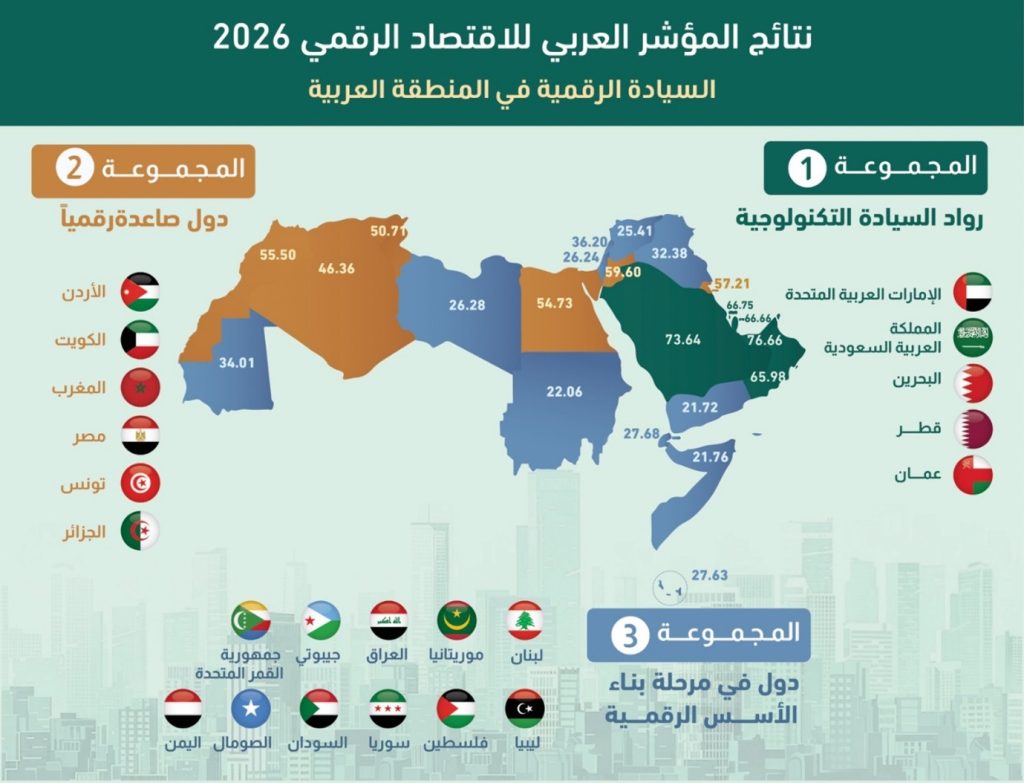
The index results showed the United Arab Emirates leading the Arab world, followed by Saudi Arabia, Bahrain, Qatar, and Oman. These five countries comprise the high-performing “digital sovereignty group,” characterized by more advanced levels of digital infrastructure, e-government, cybersecurity, and the use of modern technologies, along with increased investment in data centers, cloud services, and artificial intelligence.
Jordan, Kuwait, Morocco, Egypt, Tunisia, and Algeria were included in the “digital-emerging” group, having made progress in connectivity, government services, and digital infrastructure, while still needing to expand their capabilities in innovation, research and development, advanced skills, and to further integrate digital investments with economic activities and markets. The third group, which the report classifies as countries in the “digital foundation building” phase, includes Lebanon, Mauritania, Iraq, Djibouti, the Federation of the Comoros, Libya, Palestine, Syria, Sudan, Somalia, and Yemen.
The 2026 results reveal a positive trend at the regional level, with twenty Arab countries showing improved performance compared to the 2024 report, while two countries experienced a slight decline. However, the report indicates that the pace of progress varies considerably from country to country, and that improvements in services and infrastructure have not translated to the same extent into progress in the production of local technological solutions or in transforming scientific research and innovation into economically valuable products and services.
This finding highlights one of the most important messages conveyed by the new report. The Arab region has made tangible progress in digital government services, infrastructure, and cybersecurity, while there is still a significant gap in the areas of innovation, the data economy, artificial intelligence, research and development, and the transformation of technical knowledge into products, companies, and economic value.
The report concludes that the next challenge is to move from digitizing services and procedures to achieving a broader economic impact that directly affects company productivity, the growth of new sectors, job creation and investment opportunities, and increased added value in the economy.
The report places data sovereignty at the heart of the debate surrounding the future of the Arab digital economy, highlighting the increasing importance of where data is stored, how it is managed, who has access to it, and the ability of countries to operate and restore their vital systems and services during disruptions. It also links the expansion of data centers and cloud infrastructure to the ability to retain a larger share of the economic value generated by digital activities within national economies.
The report argues that this transformation is gaining increasing importance with the acceleration of artificial intelligence, cloud computing, and growing international competition for data, chips, and computing infrastructure. As economic sectors increasingly rely on these technologies, digital resource management has become inextricably linked to investment, productivity, business continuity, and competitiveness, and is no longer a purely technical issue separate from economic policies.
The findings also show that in several Arab countries, the readiness to adopt new technologies is progressing faster than the capacity to produce and develop them locally. The report identifies this gap between technology adoption and production as a key challenge facing the region, particularly in research and development, the transformation of knowledge into digital products and services, and the connection of universities and research centers with businesses and markets.
In the field of data and artificial intelligence, the report indicates that a number of Arab countries have begun to build national strategies and use advanced analytics and smart applications in government, the financial sector, cities and services, but the greatest economic opportunity is related to their ability to move from merely using these technologies to building data systems that can generate new value and support investment, business models and production.

The new report links country results to the path each group will take in the coming years. Countries with advanced digital capabilities face a different challenge: moving from simply adopting technology to localizing and developing it, and increasing local research and development and technological production. Emerging digital countries prioritize achieving greater integration between digital infrastructure, skills, innovation, and markets. And in countries still in the foundation-building phase, the focus is on communication networks, essential government services, and building the institutional and human capacity necessary for digital transformation.
The report places particular emphasis on Arab cooperation, arguing that developing a more interconnected regional digital market can expand opportunities for companies and investors, support data center and cloud infrastructure projects, and improve interoperability between national platforms. It also calls for greater convergence in data governance frameworks, cybersecurity, and technical standards, and for the development of Arab mechanisms for exchanging expertise and skills and supporting technology companies in accessing larger regional markets.
On the methodological side, the fifth edition is based on nine key pillars that have been reorganized into eight analytical axes covering governance and digital institutions, infrastructure, human capital, innovation and technology, the data economy and artificial intelligence, digital and financial inclusion, cybersecurity and data sovereignty, and economic and social impact.
The database is based on published international sources and, where available, official national data, including those from the World Bank, the United Nations, the International Telecommunication Federation, the Organisation for Economic Co-operation and Development, the International Monetary Fund, and other specialized international organizations. The results underwent sensitivity and robustness testing, and the report adopted a conservative approach to addressing data gaps. In cases requiring supplementary data, the countries concerned were contacted in coordination with the League of Arab States, provided that the submitted data had been previously published by a governmental or independent entity.
The report emphasizes that the index should be treated as a comparative and analytical tool for monitoring trends and relative gaps between countries, not as a definitive or absolute measure of performance, given the differences in data quality, timing of publication, and coverage among countries. This methodological clarification is important because it places the ranking results in their proper context and allows them to be used to guide policies and investments without overburdening the ranking methodologically.
The Arab Digital Economy Index is published every two years, and the 2026 edition is the fifth in the series. This year’s edition focuses on the relationship between digital sovereignty and economic competitiveness, at a time when data, artificial intelligence, cloud infrastructure, and cybersecurity are increasingly influential factors in a country’s ability to attract investment, develop new industries, and boost productivity.