




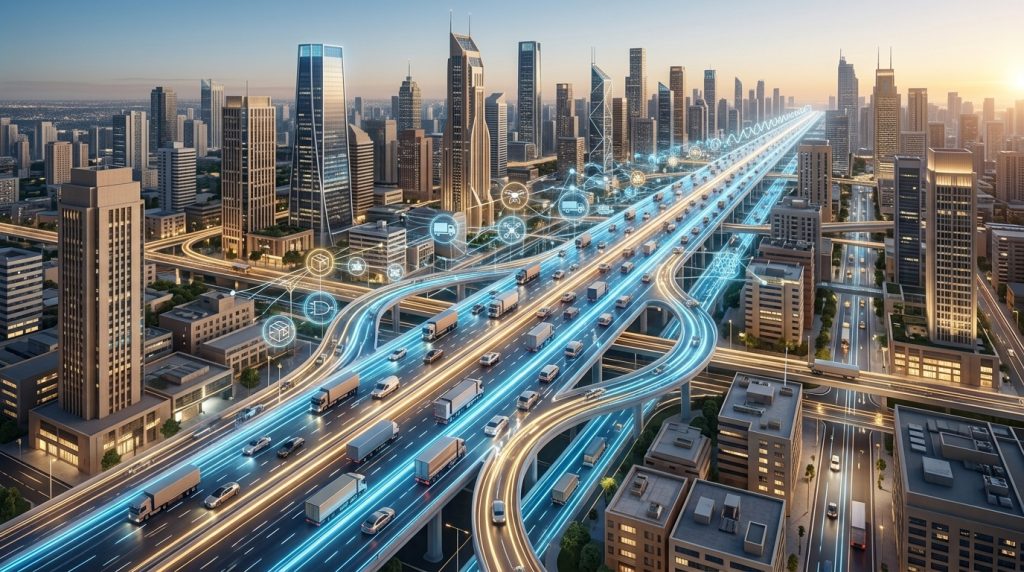
Freight Transport and Fleet Management: From a Traditional Support Sector to a Sovereign Driver of the Global Digital Economy
The freight transport and fleet management sector is transforming from a traditional support service sector into a sovereign driver of the global digital economy. With the e-commerce boom, the shift toward resilient supply chains, and mandatory carbon emission reductions, the need has emerged to integrate data, artificial intelligence, and predictive analytics to manage hundreds of thousands of vehicles with extreme precision and in real time. This article reviews the economic and technical dimensions of this transformation, with an in-depth analysis of AI applications in the sector, supported by examples from leading global companies and reliable market indicators.
First: The Role of Fleet Management and Its Place in the Digital Economy
The growth of the digital economy cannot be understood without tracking the movement of vehicles carrying goods; major digital platforms depend entirely on “last-mile delivery” to ensure customer satisfaction. Fleet management has become a fundamental pillar of digital economy infrastructure, as vehicles have transformed from mere means of transport into “mobile data centers” that generate enormous amounts of data through sensors on fuel consumption, driving behavior, engine status, and surrounding conditions.
Financial Indicators and the Growing Market Size
Market estimates indicate accelerating growth in the digital fleet management sector. In 2024, the global digital fleet management market was estimated at about $924 million, with projections of rising to $1.482 billion by 2031, at a compound annual growth rate (CAGR) of 7.1%. This growth reflects the increasing adoption of cloud solutions, IoT, and AI technologies in vehicle management.
More specifically, the AI-powered fleet management software market is estimated at about $826 million in 2024, with projections of jumping to $1.4 billion by 2031, at a CAGR of 7.8%. This trajectory reflects faster growth for smart solutions compared to traditional digital management solutions, indicating a fundamental shift in investment strategies toward AI-based systems.
Estimates from other sources indicate that the total size of the AI-powered computer vision solutions market in public transport vehicles alone reached about 8.4 billion RMB (about $1.2 billion) in 2024, with a CAGR of 19.1% between 2020 and 2024, with expectations of continued growth at 21.1% through 2030.
Projected growth of the AI-powered fleet management market ($ million):
-
2024: $826 million
-
2031: $1,400 million
(Source: QY Research, 2025)
Drivers of Integration into the Digital Economy
Several factors drive the integration of fleet management into the heart of the digital economy:
-
Big data generation: Trucks are no longer mere means of transport but have become mobile data centers generating massive data through sensors on fuel consumption, driving behavior, weather, and engine status. This data feeds digital economy infrastructure.
-
A decisive factor in e-commerce: Digital efficiency in fleet management enables lower fixed costs, allowing online stores to offer same-day delivery features at competitive prices.
-
Advanced technical integration: The sector is witnessing increasing integration with AI, machine learning, and IoT technologies, enhancing predictive analytics and automating decision-making processes.
-
Sustainability and electrification: Interest in electric vehicles and sustainability initiatives is gaining increasing importance, driving the development of solutions supporting electric fleet management, including charging infrastructure integration, range optimization, and carbon footprint tracking.
Second: The Pivotal Impact of AI on the Sector
Thanks to AI, the fleet management sector has moved from “reactive” management (waiting until a problem occurs) to “predictive and proactive” management. AI-powered fleet management software is defined as an advanced digital platform that leverages AI, machine learning, and data analytics to optimize the operation, safety, and efficiency of commercial vehicle fleets.
Dynamic Route Optimization
AI-powered fleet management systems integrate real-time GPS tracking, telematics, driver behavior monitoring, predictive maintenance, and fuel consumption analysis into a unified system. By processing large volumes of operational data, AI algorithms can predict potential vehicle failures, suggest optimal routes, reduce downtime, and improve driver performance.
Traditional GPS-based algorithms drew static routes. Modern machine learning algorithms, however, analyze real-time traffic flow, weather forecasts, customer delivery preferences, and even the usual opening and closing times of factory gates to automatically reroute trucks with the lowest possible fuel consumption.
Predictive Maintenance Based on Deep Learning
By linking sensor data installed in the transmission, engine, and brakes, AI can detect anomalous patterns and subtle vibrations that precede a mechanical failure by weeks. This prevents sudden breakdowns on highways and reduces maintenance costs by 15% to 20%, according to industry estimates.
Computer Vision and Telematics for Driver Safety
AI-powered smart cameras are installed inside driving cabins to precisely monitor the driver’s face. Once distraction, phone use, or signs of drowsiness and fatigue appear, the system issues an immediate audio warning to the driver and sends a report to the control room. Computer vision solutions in public transport vehicles have witnessed rapid growth, with the top five companies’ share of this market reaching 41.3% of global revenues in 2024.
Third: Case Studies of Leading Global Companies
Major logistics giants have applied AI in managing their fleets, achieving results that have changed the face of the industry:
UPS and the “ORION” Smart System
UPS is among the world’s most prominent pioneers in this field. The company developed the ORION (On-Road Integrated Optimization and Navigation) system based on reinforcement learning algorithms and big data. The system analyzes more than 250 million data points daily for delivery vehicles, contributing to savings of nearly 100 million miles of driving annually—equivalent to saving about 10 million gallons of fuel and reducing carbon emissions by 100,000 metric tons.
Samsara: The Largest Player in the Market
Samsara is among the most prominent players in the market for fleet management solutions powered by computer vision and AI, capturing the largest market share in 2024 at 29.1% of global revenues in this sector. The company offers connected cloud services for industries including construction, transportation, and utilities, integrating sensors, cameras, and cloud analytics platforms to provide comprehensive visibility into fleet performance.
Netradyne: A Leader in Video Analytics
Netradyne is a leading company in video telematics, ranking second with a market share of 14.9% of the computer vision solutions market in transport vehicles for 2024. Its Driver•I platform uses road-facing and driver-facing cameras with advanced computer vision algorithms to analyze driving behavior and provide real-time feedback, contributing to improved safety and reduced accidents.
Geotab: The Open Data Platform
Geotab is among the most prominent providers of digital fleet management platforms, offering integrated solutions combining tracking, vehicle data analytics, and compliance management, with an open data platform that allows developers to build custom applications on top of the data infrastructure.
Chinese Presence in the Market
Frost & Sullivan data indicate the presence of prominent Chinese companies in the computer vision solutions market, with one Chinese company ranking second with a 9.2% share and another Chinese company ranking third with a 5.2% share, reflecting the growing technical capabilities of Chinese companies in this field.
Fourth: Conclusion and Future Outlook
Vehicle fleet management has moved beyond the concept of simple logistics to become a fundamental pillar in the automated sustainability of the digital economy. The future direction is moving rapidly toward:
-
Smart electric vehicle fleet management (EV Fleets): Demand is increasing for solutions supporting electric vehicle management, including charging infrastructure integration, range optimization, and carbon footprint tracking.
-
Cloud and mobile solutions: Adoption of cloud and mobile solutions is increasing, enabling real-time data access, improved collaboration, and flexibility in managing fleets from anywhere.
-
Fully autonomous fleets: Paving the way for operating fully autonomous fleets, where AI systems will play a pivotal role in managing and coordinating these vehicles.
Companies that do not invest in software infrastructure and AI for managing their vehicles will suffer from thin profit margins and stifling operational costs that push them out of the digital competition. Market share analysis of major companies shows that the market is increasingly concentrating around players offering integrated solutions combining hardware, software, and cloud analytics platforms.
Sources and References
-
QY Research. (2025). AI-Powered Fleet Management Software – Global Market Share and Ranking, Overall Sales and Demand Forecast 2025-2031.
-
Frost & Sullivan, via HKEX disclosure documents. (2025). Market Size and Competitive Landscape of Global Vision-Based AI Solution in Public Transportation Vehicle.
-
QY Research. (2025). Digital Fleet Management – Global Market Share and Ranking, Overall Sales and Demand Forecast 2025-2031.