




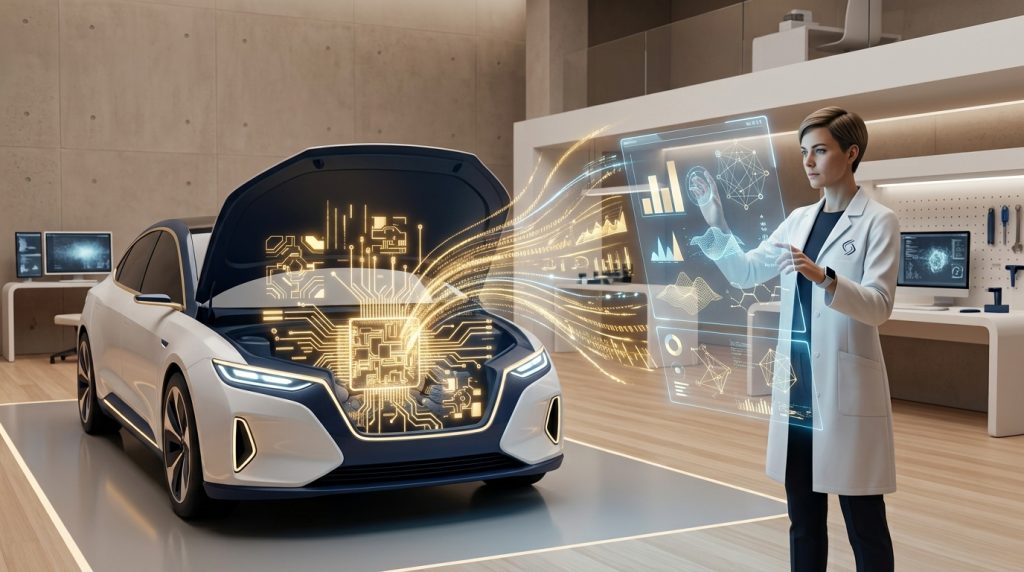
The Shift to Electric Vehicles: Redefining the IT Engineer’s Role in the Automotive Sector
The shift toward electric vehicles is no longer merely a swap of power source from fuel to batteries; it is a radical redefinition of the vehicle’s very identity. Today, the car is described as a “computer on wheels,” where software, data, and connectivity have become the distinguishing elements of added value, surpassing traditional mechanics. This qualitative leap is driving a profound transformation in the functions of IT engineers, generating a wave of both challenges and opportunities. This article reviews the various dimensions of this impact, from workforce restructuring to the emergence of new skill requirements, drawing on the latest reports and field studies.
First: From Mechanic to Software Engineer — A Fundamental Shift in Demand
The essence of the transformation is that added value in the modern electric vehicle is no longer measured by engine power, but by processor power and software capabilities. This trend, known as the Software-Defined Vehicle (SDV), has placed IT engineers at the heart of the industry.
1. Growing Demand for Software and AI Engineers
Studies indicate a surge in demand for technical skills. In Germany, the automotive sector faced a specialized skills shortage of about 80,000 jobs in 2024, and the shortage in Europe is expected to reach 260,000 workers by 2030. Software engineers, AI specialists, data analysts, and cybersecurity experts top the list of most in-demand professions.
-
A real-world confirmation: In a step that clearly reflects this shift, General Motors announced in May 2026 the layoff of between 500 and 600 IT employees, replacing them with engineers specialized in AI systems. This was not a cost-saving move, but a deliberate “skills swap” to keep pace with the company’s new strategy of developing vehicles that rely entirely on software, where 90% of autonomous driving software code is now written by AI.
2. The “War for Talent”: Competition with Tech Giants
Automotive companies now find themselves in direct competition with tech giants such as Google and Apple for the same scarce talent. According to a report by Josh Bersin, the automotive industry ranks low in sector comparisons in terms of the maturity of its recruiting and retention practices for technical talent, still relying on traditional seniority-based systems rather than skill-based ones.
Second: Challenges of the Transformation and Risks to Traditional Jobs
While this transformation opens new horizons, it carries real risks for certain job categories.
1. Displacement of Old Skills and Their Replacement by AI
As the General Motors case showed, there is a real risk that some IT skills will become “obsolete” in the face of AI automation. A survey by QNX of 1,100 automotive software developers found that 91% of them expect AI to play a transformative role in the coming years, and they estimate that 35% of current jobs may be replaced by AI tools by 2035.
2. Scarcity of New Skills
The other side of the coin is the acute shortage of new skills required. In the UK, the Institute of the Motor Industry (IMI) expects a shortage of technicians capable of maintaining electric vehicles, threatening to delay repairs and raise their costs. In India, estimates indicate a need for about 200,000 qualified workers in the EV field by 2030 to achieve the target of 30% electric sales.
Third: New Skills — What Do IT Engineers Need?
The profile of a successful engineer in the automotive sector is no longer limited to mechanical expertise. Combining engineering and technical skills has become the fundamental requirement.
1. Core Technical Skills
-
Embedded Systems: Mastery of programming languages such as C/C++ and Python, and understanding of in-vehicle communication protocols such as CAN, LIN, and Ethernet.
-
Data Engineering and AI: Analyzing massive amounts of data from sensors, and developing machine learning algorithms for autonomous driving and predictive maintenance.
-
Cybersecurity: As the car becomes a connected device, its cybersecurity has become a top priority, especially with regulations such as UNECE WP.29 and ISO/SAE 21434.
-
HMI/UX: Designing intuitive interfaces that interact with the driver and provide a seamless user experience.
2. Soft Skills
-
Collaboration and Teamwork: Complex projects require multidisciplinary teams working together across geographic borders.
-
Problem-Solving and Decision-Making: The ability to handle failures and make rapid decisions in decentralized production environments.
-
Familiarity with Modern Workplace Technologies: 72% of technical professionals now consider remote work non-negotiable, requiring skills in using cloud-based and digital collaboration tools.
Fourth: Strategies for Bridging the Gap — Reskilling and Human Investment
Facing this challenge, automotive companies are adopting multiple strategies to secure their future:
1. Reskilling the Current Workforce
Investing in employee reskilling and upskilling is a fundamental pillar. Mercedes-Benz launched a lifelong learning initiative worth €1.3 billion, qualifying 74,000 workers in 2024 alone in areas such as battery analysis and automotive cybersecurity. Companies such as BMW also use virtual reality in training, reducing costs by about €12,000 per employee and achieving a knowledge retention rate of up to 98%.
2. Partnership with Academic Institutions
Collaboration with universities to develop curricula that keep pace with market needs has become vital. In India, the Automotive Skills Development Council (ASDC) collaborates with major manufacturers to offer certified training courses in EV technologies and mechatronics. In Italy, universities in Emilia-Romagna collaborate with local industry on industrial PhD programs to achieve a better balance between theory and practice.
3. Transforming the Work Environment to Attract Talent
It is no longer just about salary, but about the work environment. Automotive companies that cling to traditional work models (mandatory attendance, hierarchical management) find it difficult to attract young engineers from Generations Z and Y who expect flexibility and modern digital tools. The “digital workplace” strategy—including unified endpoint management (UEM) and AI-powered self-service portals—has become a competitive element for attracting and retaining talent.
Fifth: Conclusion and Future Outlook
The shift toward electric vehicles and software-defined vehicles represents a decisive moment in the history of the automotive industry, but also a pivotal moment in the history of technical employment. The impact on IT engineers is not limited to creating new jobs; it radically redefines what these jobs are.
The future will belong to the IT engineer capable of:
-
Continuous Adaptation: Because the skills landscape is expected to change rapidly, with AI tools expected to replace 35% of current roles.
-
Cross-Disciplinary Specialization: Combining knowledge of mechanical and electronic systems, software, and data analysis.
-
Flexibility: Engaging in digital and collaborative work environments, away from the traditional factory model.
Companies and institutions that invest today in reskilling their workforce and creating an attractive work environment will hold the key to leading tomorrow. As for IT engineers, the message is clear: the car you will drive tomorrow is not just a vehicle—it is a software platform waiting for someone to write its code.
Sources and References
-
Getronics. (2025). Automotive Industry Transformation: Battle for Talent.
-
The Next Web. (2026). GM lays off 600 IT workers in AI skills swap.
-
LinkedIn / Cade Bryant. (2024). How to be a successful electric vehicle expert in the UK.
-
LinkedIn / Isha Chitnis. (2025). Engineers in fast lane for EV jobs.
-
QNX / Nasdaq. (2025). QNX Research Reveals Regulatory Pressure and Development Bottlenecks Are Stalling SDV Progress.
-
Crain’s Detroit Business. (2024). Auto companies struggle to recruit and retain software and tech talent.
-
Randstad. (2025). Futuro laboral de automoción conectada y autónoma.
-
Automotive Skills Development Council (ASDC). (2026). Future Automotive Jobs in India: Skills That Will Dominate by 2030.
-
Institute of the Motor Industry (IMI). (2026). Automotive sector opens the door to high-tech green careers.
-
Marsh. (2025). Net-zero automotive future: critical skills and workforce strategies.
-
SpenglerFox. (2025). Talent Trends in the European Automotive Industry.
-
CESifo. (2024). EconPol Forum: The Automotive Industry in Transition.
-
Technopolis Group. (2020). Game-changing technologies: Exploring the impact on production processes and work.