




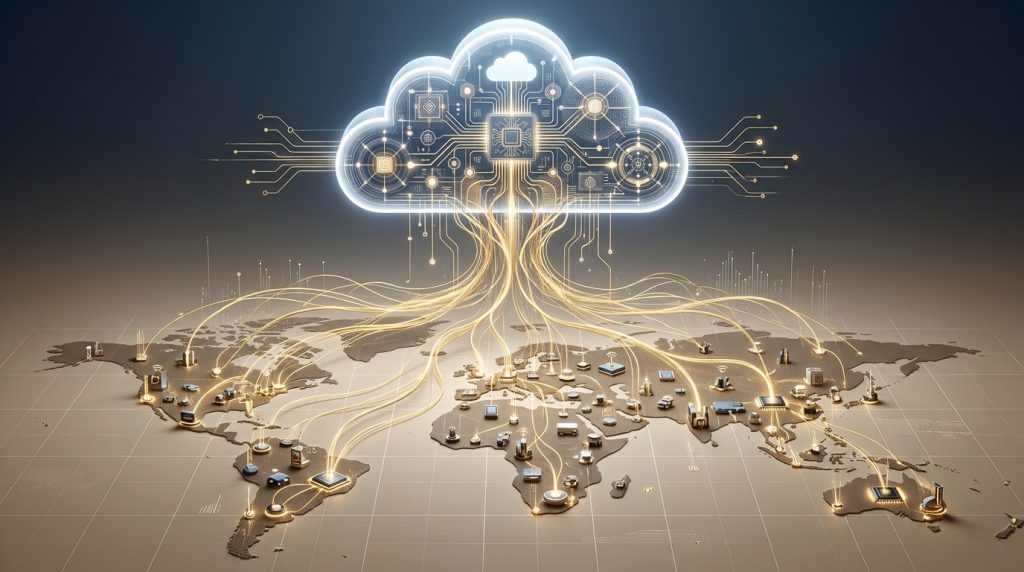
Cloud Computing Alone Is No Longer Enough: The Shift Toward Distributed “Device-Edge-Cloud” Architecture
The question of whether cloud computing is sufficient to deliver solutions for web and mobile applications is no longer merely a technical debate; it has become a strategic question facing decision-makers in every technology company. The latest studies and reports indicate that the clear answer is: no, the cloud alone is no longer enough—but the solution is not to abandon it, rather to redefine its role within a hybrid architecture spanning from the device (On-Device) to the edge (Edge) to the cloud (Cloud). This article, based on recent academic research and industry reports, analyzes the fundamental reasons why the centralized cloud model faces existential challenges, and reviews the shift toward “distributed computing” as the framework for the next decade.
First: When Latency Becomes a Barrier — The Limits of Centralized Cloud
Cloud computing has long been a centralized model: your applications and data live in remote data centers, and requests travel back and forth over the internet. But this model today faces physical and technical constraints that cannot be easily overcome.
1. The Latency Problem: Physics Imposes Itself
The speed of light is not just a number in a physics equation; it is a physical upper limit. When data travels from a user’s device to a remote cloud (which may be hundreds or thousands of kilometers away) and back, that journey takes time. For applications like video streaming, this delay may be imperceptible, but for augmented reality, autonomous vehicles, or cloud gaming, even 50 milliseconds of delay can be fatal to the experience.
A recent academic study showed that interactive latency in mobile cloud gaming platforms ranged between 112 and 403 milliseconds—far higher than the required threshold (under 100 milliseconds). More surprisingly, the network was responsible for only 17% of this latency; the rest was consumed within the cloud system itself in processing, encryption, and synchronization. This shows that the problem is not only in data transmission but in the cloud’s architecture itself.
2. The “Butterfly Effect” in Cloud Systems
The same study revealed a striking phenomenon: a very slight fluctuation in the network (2 milliseconds or less) can lead to a large swing in response time (10 milliseconds or more) within the cloud system. This is because cloud systems rely on tight timing between different processing stages; any small delay in one stage can disrupt synchronization with subsequent stages, causing delays to accumulate. This makes cloud performance less predictable than many might think.
Second: New-Era Solutions — The Distributed “Edge-Cloud” Architecture
Facing these constraints, a new architectural model is emerging that does not replace the cloud but complements it: the “Device-Edge-Cloud” (End-Edge-Cloud) architecture. The essence of this model is distributing computing tasks across three layers:
-
On-Device Layer: Executing simple, privacy-sensitive, or instant-response tasks on the user’s own device (phone, car, smart camera). This includes running small, specialized AI models locally.
-
Edge Layer: Moving parts of the application logic to servers close to the user, such as those deployed in content delivery networks (CDNs). Here, requests requiring low latency (under 50 milliseconds) can be processed and data cached to reduce pressure on the central cloud.
-
Cloud Layer: Retaining the cloud for heavy tasks requiring enormous computing power, such as training large AI models, long-term storage, big data analytics, or orchestrating and managing the entire distributed network.
Comparison Between the Two Models: Centralized Cloud vs. Distributed Computing
| Feature | Traditional Centralized Cloud Model | Distributed Model (Device-Edge-Cloud) |
|---|---|---|
| Latency | High (hundreds of milliseconds); unsuitable for real-time applications | Very low (units or tens of milliseconds); ideal for real-time applications |
| Scalability | Easy and flexible on a global scale thanks to cloud infrastructure | Requires planning and physical deployment at each site, but distributes load |
| Privacy and Security | Data travels and concentrates in data centers; broader risks | Sensitive data can be processed locally, reducing exposure and improving compliance |
| Reliability | Central point of failure; cloud outage affects everything | Self-healing mesh network; failure of one node does not paralyze the system |
| Cost | Pay-as-you-go model, but transport and storage costs may rise | Reduces transport costs through local processing, but with maintenance costs for distributed devices |
Third: Drivers of the Shift — Why Is the Industry Moving to the Edge?
Three main pressures explain why this shift is not merely a passing trend but an inevitable necessity:
1. Economic Pressure
Building and operating massive data centers costs billions and consumes energy equivalent to a small city. In contrast, user devices (phones, computers) possess enormous computing capabilities that remain idle most of the time. New distributed computing markets allow renting these idle capabilities at a much lower cost.
2. Technical Pressure (Real-Time AI Applications)
Generative AI applications have become an essential part of the user experience. Running huge models in the cloud for every request is costly in terms of cost and latency. Task distribution has begun between “small models on the device” for personal and fast tasks, and “large models in the cloud” for complex tasks. This “Large-Small Model Coordination” is the essence of modern systems for smart mobile applications.
3. Privacy Pressure
With tightening data protection laws such as GDPR and growing user awareness, sending all user data to the cloud has become a risky decision. Platforms such as Android and Apple adopt clear strategies to run as much AI as possible locally on the device to preserve privacy, with options to resort to a “private cloud” for heavier tasks.
Fourth: Is the Cloud on Its Way to Extinction? — Its Changing Role
The short answer: no. The cloud is not on its way to extinction; rather, its role is changing. Massive data centers will not disappear; they remain essential for:
-
Archive storage: Preserving enormous amounts of historical data.
-
Training giant AI models: Which require thousands of GPUs working in parallel.
-
Orchestrating and managing the distributed network: The cloud becomes the “brain” of orchestration rather than the “muscle” of execution for every small operation.
The future belongs to hybrid or multi-cloud architectures, where the best environment is chosen for each task based on its requirements for speed, cost, privacy, and reliability. About 76% to 85% of large and medium-sized enterprises are moving toward these strategies.
Fifth: Conclusion and Future Outlook
Cloud computing, in its centralized model, has become insufficient on its own to meet the requirements of the current generation of web and mobile applications, especially those relying on AI that demand instant response and high privacy. The solution is not to abandon it, but to integrate it with edge computing and on-device computing in a smart distributed architecture. This shift redefines the cloud from being “the center” to being “a node” within a broader, smarter, and more flexible network.
For companies and developers, the message is clear: the future of successful applications will belong to those who master the art of distributing workload among the device, the edge, and the cloud—not to those who insist on the “everything in the cloud” model, which now carries constraints that cannot be ignored.
Sources and References
-
FH St. Pölten – SOTA: Edge Computing for Web Applications (2026)
-
EconPapers – Practice of Mobile Application LLM System Driven by End-Edge-Cloud Collaboration (2026)
-
Bluehost / NSDI ’25 – Dissecting and Streamlining the Interactive Loop of Mobile Cloud Gaming (2025)
-
Fast Company – On-device versus cloud isn’t a performance choice (2026)
-
BluBØX – The Next Five Years (2026-2030)
-
DigitalOcean – Edge Computing vs Cloud Computing: Key Differences Explained
-
Forbes – The End Of Centralized Compute: Why The Edge Is Taking Over (2026)
-
Liquid Web – Top Cloud Computing Trends In 2026
-
TechChannel – When Cloud Is Better Than Mainframe (and When It’s Not) (2026)