




The Integration of Edge Computing and the Cloud: From Centralization to a Distributed “Computing Continuum”
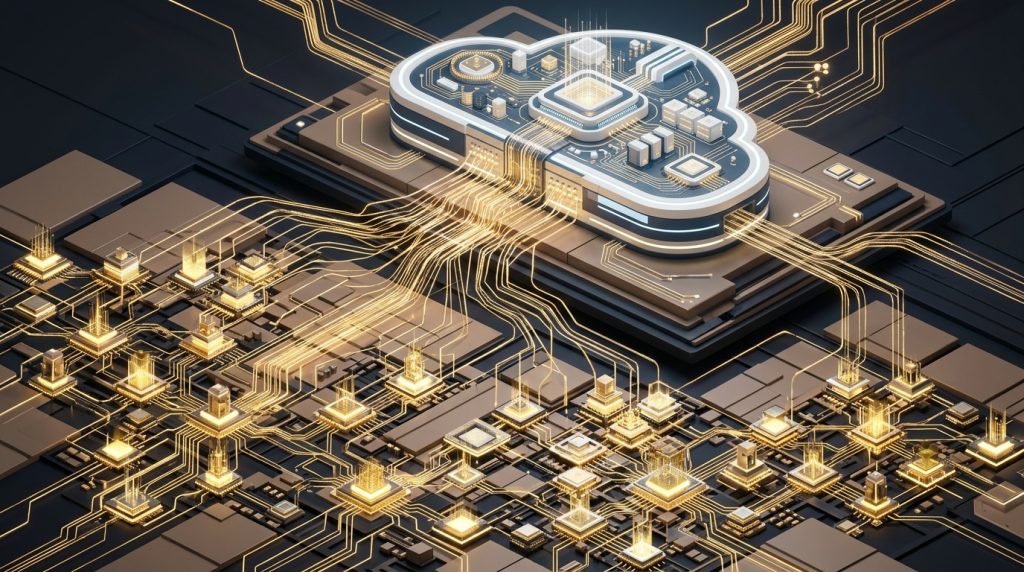
The integration of edge computing and the cloud represents a fundamental architectural shift in the structure of the digital economy, moving from a centralized model to a “Computing Continuum” extending from endpoint sensors to massive data centers. Studies indicate that the global edge AI market reached about $35.8 billion in 2025, with projections to exceed $385 billion by 2034, reflecting an irreversible economic shift toward distributed computing. This article analyzes the architectural and economic dimensions of this integration, reviewing operating mechanisms, practical applications, and the challenges facing this path.
First: From Centralization to the Continuum — Redefining Digital Infrastructure
1. The Limits of the Centralized Model
Cloud computing has long relied on a centralized model: data is sent from user devices to remote data centers for processing, and results are returned. But this model faces strict physical constraints in the era of the Internet of Things (IoT) and real-time AI. Studies have shown that latency is the biggest obstacle: applications requiring sub-50-millisecond response—such as automated control systems, real-time fraud detection, and autonomous vehicles—cannot be served by a round trip to the cloud, regardless of computing cost.
Data egress costs also represent an unexpected structural burden. In industrial facilities generating 10 terabytes of sensor data daily, raw transport costs may exceed $260,000 annually before any AI processing is performed. This reality has pushed the industry to reconsider the “cloud for everything” model and seek more distributed architectures.
2. The Concept of the “Computing Continuum”
Researchers from TU Wien and the University of Oulu describe the computing continuum as “an open, seamless, and secure environment where resources—from cloud servers to the smallest edge devices—can be intelligently orchestrated, data and services can be monetized in a distributed market, and knowledge is shared through semantic interoperability.” This concept goes beyond the “cloud versus edge” dichotomy to a multi-layered model:
| Architectural Layer | Location | Primary Function | Examples |
|---|---|---|---|
| Endpoint device layer | Inside sensors and equipment | Data collection, instant task execution (TinyML) | Cameras, vibration sensors, wearables |
| Edge layer | Local gateways, nearby small servers | Data filtering, low-latency AI inference, local decision-making | Industrial servers, 5G network nodes |
| Cloud layer | Remote data centers | AI model training, big data analytics, orchestration and management of the entire network | AWS, Azure, Google Cloud |
Researchers at Germany’s Fraunhofer Institute say: “The concept of a clear separation between decentralized data processing and grid computing in remote data centers has become obsolete. Instead, the seamless integration of edge and cloud computing allows storage capacity and computing power to be used automatically at the most efficient and economical location.”
Second: The Economic Drivers of the Distributed Model
1. New Economics: When Does the Edge Beat the Cloud?
An academic analysis from Odesa National University provides a framework for determining the economic tipping point between the two models. Edge computing becomes economically superior when the daily volume of AI-processed data exceeds 370 GB, assuming a typical cloud transport cost ($0.085/GB) and an annual edge capital cost ($50,000 for 1 TB/day capacity). This figure makes most industrial applications (smart factories) and urban applications (smart cities) strong candidates for the edge model.
Conversely, the cloud remains the optimal choice for tasks requiring massive computing power (such as training large AI models) and tasks not requiring instant response, thanks to the pay-as-you-use model that converts capital expenditures into flexible operating expenses.
2. New Models: The Idle Resource Economy
Decentralized edge computing models leverage the idle resources of millions of devices worldwide. Startup Hyra is developing a “sharing economy” model for computing, using idle computing power in smartphones and laptops to provide AI infrastructure services at a cost equal to only 40% of the average prices of traditional providers, saving customers up to 60% of infrastructure costs. This model, philosophically similar to Grab or Airbnb platforms, transforms millions of individual devices from data consumers into producers of computing capacity, redefining the very concept of a “data center.”
Third: Architectural Challenges — From Fragmentation to Integration
Despite enormous potential, the transition to the computing continuum faces three main challenges:
1. Architectural Fragmentation and Vendor Lock-in
Cloud providers have treated edge computing as an extension of their own proprietary infrastructure, creating isolated deployments where edge devices must run vendor-specific technologies and cannot easily integrate with third-party services. This fragmentation impedes interoperability and creates vendor lock-in risks, contradicting the vision of an open computing continuum.
2. Orchestration Gaps
Native cloud orchestration platforms (such as Kubernetes) face difficulties in diverse, resource-constrained edge environments, as these platforms assume reliable connectivity and homogeneous infrastructure, while edge devices vary greatly in capabilities and operating conditions. Researchers in the HERMES framework proposed using WebAssembly (WASM) as a potential solution, providing portable binaries that can run on any hardware platform via a lightweight runtime, achieving “write once, run anywhere” for heterogeneous environments.
3. Trust and Security in Distributed Environments
With more entry points—from edge devices to cloud endpoints and communication protocols—the attack surface expands significantly. Experts recommend adopting a Zero Trust model, where every data packet is authenticated and encrypted, whether at rest or in transit. Recommended technologies include mutual TLS authentication, device identity verification, and role-based access control.
Fourth: Vital Applications — Models Reshaping Sectors
1. Smart Manufacturing (Industry 4.0)
Industrial applications represent the most compelling economic case for edge computing. A typical smart factory generates between 1 and 10 terabytes of sensor and vision data daily. Running AI inference locally—for defect detection, predictive maintenance, and process optimization—avoids enormous transport costs and achieves instant response. Industry reports indicate savings of 30–40% when moving AI inference to the edge, and manufacturing is the largest vertical market segment for edge AI adoption.
2. Smart Cities and Society 5.0
A new architectural model (Serverless Edge-Cloud) combines cloud and edge to support knowledge management operations in smart cities, aligned with the human-centric, data-driven Society 5.0 vision. The edge processes time-sensitive data (such as traffic management, public safety, and emergency response) locally, while the cloud is used for long-term analytics and model training. Experiments have shown that this model significantly reduces data transfer times and eliminates network congestion, while providing cost-effective computing options.
3. Massive IoT and Telecommunications
The integration of edge and cloud combines the edge’s instant response capability with the cloud’s centralized orchestration and long-term storage. In smart manufacturing scenarios, case studies have shown that this hybrid architecture significantly improves data processing efficiency, system reliability, and decision-making speed.
Fifth: Conclusion and Future Outlook
The digital economy is heading toward a hybrid decentralized model, where cloud and edge are no longer competitors but complementary partners in a unified computing continuum. Economic analysis shows that this integration is not merely an engineering improvement but an economic necessity for real-time, data-intensive AI applications.
Future trends point to three main axes:
-
Maturation of orchestration frameworks: With the spread of technologies such as WebAssembly and serverless computing in edge environments.
-
Economics of distributed computing: With the flourishing of decentralized marketplace models for idle computing resources, significantly lowering AI infrastructure costs.
-
Security and privacy standards: With the development of unified frameworks for trust and security in distributed environments, combining strict authentication and comprehensive encryption.
The message is clear: the future of the digital economy lies not in the cloud alone, nor in the edge alone, but in the seamless flow of data and computing across a continuum extending from the smallest sensor to the largest data center, with computing capabilities dynamically moved to where the need is most urgent and efficient.
Sources and References
-
arXiv. (2025). Synergizing Monetization, Orchestration, and Semantics in the Computing Continuum. HERMES Framework.
-
Scientific Reports. (2025). AI edge cloud service provisioning for knowledge management smart applications. Nature, 15, 32246.
-
Zenodo. (2026). Edge AI Economics: When Edge Beats Cloud. Odessa National Polytechnic University.
-
Vietnam Economic Times. (2025). Harnessing idle computing power. Interview with Hyra Holdings CEO.
-
Journal of Research and Advancement in Electrical Engineering. (2025). Empowering Massive IoT with Edge and Cloud Synergy.
-
IEEE Xplore. (2025). Towards a Converged Telco Edge Cloud: Architecting the 3C Network.
-
Express Computer. (2026). Why the future of datacentres is becoming closer to everyday life than we think.
-
ScienceDirect. (2026). Blockedge: Blockchain-based cloud-edge-end collaborative computing. Elsevier.
-
NASSCOM Community. (2026). Cloud Trends in 2026: Multi Cloud, Edge, Serverless.
-
Forbes. (2024). How ‘The New Cloud’ Has Changed Companies’ Approach To Cloud Strategy.
-
INFORMS PubsOnline / Analytics Magazine. (2025). On the Edge and in the Cloud: The Future of Real-time Data Flows.
-
Fraunhofer CCIT. (2025). Edge-Cloud continuum.